
How long can a puppy stay in a crate? The answer depends on age, and the safe limits are shorter than most new owners expect. Crate time is one of the most common questions new puppy owners ask, and for good reason. A crate that is used correctly builds confidence and supports potty training. A crate that is used for too long, too soon, can cause stress, accidents, and even physical discomfort.
Young puppies simply cannot hold their bladder for long stretches. Their bodies are still developing, and their muscle control lags behind their curiosity. Leaving a puppy crated far beyond what their age allows can lead to repeated accidents, anxiety around the crate itself, and in some cases physical strain from holding a position too long.
The quick answer is that crate time depends heavily on age. An 8 week old puppy might only manage 30 to 60 minutes at a time during the day, while a 6 month old puppy can often handle 4 to 6 hours. This guide breaks down exact crate time ranges by age, explains the reasoning behind each stage, and covers what to do when your schedule does not match your puppy’s current limits.
Quick Answer: Puppy Crate Time by Age
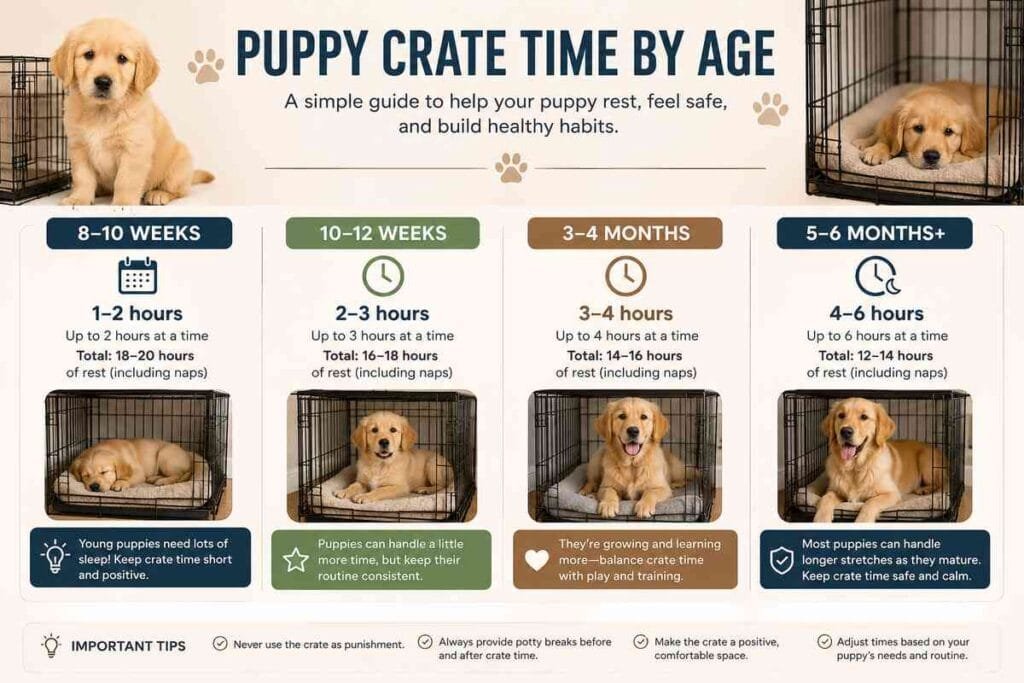
| Puppy Age | Daytime Crate Time | Nighttime Crate Time |
|---|---|---|
| 8 weeks | 30 to 60 minutes | 2 to 3 hours, with breaks |
| 10 weeks | 1 hour | 3 to 4 hours, with breaks |
| 12 weeks | 1 to 2 hours | 4 to 5 hours |
| 3 months | 2 hours | 5 hours |
| 4 months | 3 hours | 6 to 7 hours |
| 5 months | 4 hours | 7 hours |
| 6 months | 4 to 6 hours | 7 to 8 hours |
| Adult dogs | 6 to 8 hours | 8 hours |
These numbers are general guidelines rather than fixed rules. Every puppy develops at a slightly different pace, and factors like breed, health, and individual bladder control all play a role.
Why Age Matters for Crate Time
Bladder Development
A puppy’s bladder is small and still developing muscle control. A commonly used rule of thumb is one hour of bladder control per month of age, up to roughly 8 to 10 hours as an adult. This is a starting estimate, not a hard limit, since some puppies hold longer and others need more frequent breaks. Toy and small breeds sometimes need slightly more frequent breaks than the general rule suggests, simply because their bladders are physically smaller relative to how much they drink and eat throughout the day.
Treat the one-hour-per-month rule as a ceiling, not a target. The chart below stays on the cautious side. Follow the chart when the two differ.
Physical Growth
Young puppies are still building muscle strength and coordination. Long periods in one position, even a comfortable crate, can lead to stiffness or discomfort, especially in larger breed puppies growing quickly. Rapid growth phases, which often show up as sudden jumps in size over a few weeks, can also temporarily affect how comfortable longer crate stretches feel, even if your puppy handled similar stretches easily just a short time before.
Emotional Maturity
Very young puppies have not yet built the emotional tools to handle long stretches alone. Extending crate time too quickly, before a puppy feels secure, often creates anxiety around the crate rather than comfort with it. A puppy who is pushed past their emotional readiness may start showing stress signals well before their bladder is actually the limiting factor.
Separation Tolerance
Tolerance for being alone builds gradually, similar to how potty training builds gradually. Puppies who are pushed into long alone periods too early sometimes develop separation related behaviors that take much longer to unwind than they would have taken to prevent. Building tolerance in small, successful increments tends to produce a far more confident adult dog than forcing long stretches before your puppy is ready.
Puppy Crate Time Chart by Age
8 Weeks
Maximum daytime crate time: 30 to 60 minutes at a stretch
Nighttime: 2 to 3 hours between breaks
Potty schedule: Every 30 to 45 minutes while awake
Exercise needs: Short, gentle play sessions several times a day
Feeding timing: 3 to 4 small meals daily, with a potty break shortly after each one
At this age, the crate should mostly be used for short naps and overnight sleep with frequent breaks, not extended alone time.
Tip: Keep the door open during waking hours whenever possible at this stage, so your puppy learns to see the crate as a cozy resting spot rather than a place they are locked away from you.
10 Weeks
Maximum daytime crate time: About 1 hour
Nighttime: 3 to 4 hours between breaks
Potty schedule: Roughly every hour while awake
Exercise needs: Slightly longer play sessions, still frequent and short
Feeding timing: 3 meals daily, with a consistent potty break after each
By 10 weeks, most puppies are beginning to show early signs of bladder control improvement, though accidents remain common.
Tip: This is a good stage to start layering in short, low-pressure crate sessions during the day, even when you are home, so alone time does not feel new or stressful once you actually need it.
12 Weeks
Maximum daytime crate time: 1 to 2 hours
Nighttime: 4 to 5 hours, often with one overnight break still needed
Potty schedule: Every 1 to 2 hours during the day
Exercise needs: Structured play and short walks, depending on vaccination status
Feeding timing: 3 meals daily, spaced evenly
This is often the age when families start testing slightly longer crate stretches, though full workday lengths are still too much.
Tip: If you are planning to return to work soon, this is the stage to start researching a midday dog walker or daycare option, rather than waiting until the last minute.
3 Months
Maximum daytime crate time: About 2 hours
Nighttime: Around 5 hours
Potty schedule: Every 2 hours while awake
Exercise needs: Longer supervised play, gentle leash walks
Feeding timing: 3 meals daily
Tip: Watch for early signs of boredom rather than just bladder discomfort during crate time at this stage. A bored puppy left alone too long often chews or scratches even when their bladder is fine.
14 to 16 Weeks
At 14 to 16 weeks, plan for about 2 to 3 hours during the day. That sits between the 3-month and 4-month guides. Offer a potty break right before and right after each stay.
4 Months
Maximum daytime crate time: About 3 hours
Nighttime: 6 to 7 hours
Potty schedule: Every 3 hours during the day
Exercise needs: More structured exercise, including short walks
Feeding timing: 2 to 3 meals daily, depending on breed size
Tip: Many puppies go through a teething phase around this age. Offering an appropriate chew toy inside the crate can redirect that urge and make crate time feel more rewarding.
5 Months
Maximum daytime crate time: About 4 hours
Nighttime: Around 7 hours
Potty schedule: Every 3 to 4 hours
Exercise needs: Regular walks and active play sessions
Feeding timing: 2 to 3 meals daily
Tip: If your puppy has been reliable but suddenly starts having accidents again around this age, it is often tied to a growth spurt or a schedule change rather than a training failure.
6 Months
At 6 months, many puppies handle 4 to 6 hours. If your puppy still has accidents, stay closer to 4 hours and add a midday potty break.
Maximum daytime crate time: 4 to 6 hours
Nighttime: 7 to 8 hours
Potty schedule: Every 4 hours
Exercise needs: Daily walks plus mental stimulation like puzzle toys
Feeding timing: 2 meals daily for most breeds
Tip: Six months is a common milestone where owners start testing a full workday stretch. Build up to it gradually rather than jumping straight from 4 hours to 8 hours in one step.
7 to 12 Months
Maximum daytime crate time: Up to 6 hours, working toward adult limits
Nighttime: 7 to 8 hours
Potty schedule: Every 4 to 6 hours
Exercise needs: Full daily exercise routine appropriate for the breed
Feeding timing: 2 meals daily
By this stage, most puppies are approaching adult level bladder control, though full maturity varies by breed size, with smaller breeds often maturing faster than large or giant breeds.
Daytime vs Nighttime Crate Time
Night
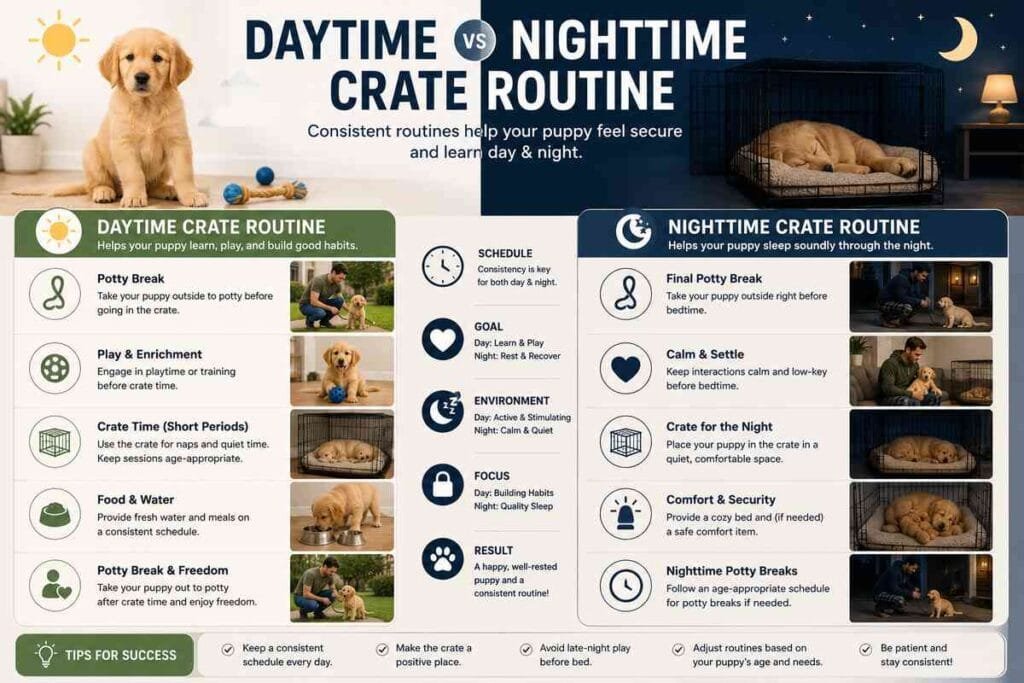
Nighttime crate stretches can generally run longer than daytime stretches at the same age. This is because sleep naturally slows digestion and reduces the urge to go, unlike active daytime hours filled with food, water, and play.
How Long Can a Puppy Stay in a Crate During the Day?
Daytime crate time needs to account for frequent potty breaks, exercise, and socialization. A puppy crated too long during the day misses out on the activity and interaction needed for healthy development, even if their bladder could technically hold longer.
Keep daytime stays short and calm. A puppy that barks after a few minutes may need a break, a potty trip, or more exercise. Our guide on why your puppy keeps barking in the crate explains what to try.
Exercise, Play, and Socialization
Crate time should always be balanced with time outside the crate for supervised play, exploration, and interaction with people and other pets. A puppy who spends most of their day in a crate, even if physically capable of holding their bladder, misses critical development windows.
If you have not yet nailed down your puppy’s overall potty routine, our how to potty train a puppy guide covers the full foundational process, and our puppy potty training schedule by age article pairs well with the crate chart above.
How Long Can a Puppy Stay in a Crate While You Work?
Full-Time Job
An 8 hour workday is longer than most young puppies can handle alone in a crate. Puppies under 4 to 5 months typically need a midday break from a family member, dog walker, or daycare service.
Part-Time Work
Shorter shifts are easier to manage, especially if you can schedule a potty break around your puppy’s current age limits.
Remote Work
Working from home makes scheduling easier, but it is still important to stick to a real potty and crate schedule rather than letting your puppy stay crated simply because you are home and busy.
Dog Walker, Family Help, or Doggy Daycare
For full-time workers with young puppies, a midday dog walker, a trusted family member, or a few days of daycare each week can bridge the gap until your puppy’s bladder control catches up with your schedule.
A Typical 8am to 3pm Workday
Many owners leave at 8am and return at 3pm. That is seven hours, which is longer than the daytime limit for any puppy in the chart above. Even a 7-month-old puppy needs a midday visit from a family member, a walker, or daycare. Build up crate time slowly and never skip the potty break before you leave.
Can a Puppy Stay in a Crate All Day?
No. Even as puppies grow older and can technically hold their bladder longer, spending an entire day in a crate is not appropriate at any age. Extended crate time without breaks can lead to several problems.
- Increased stress and anxiety
- Higher likelihood of accidents once bladder capacity is exceeded
- Muscle stiffness from staying in one position too long
- Growing anxiety specifically tied to the crate itself
- Missed opportunities for socialization and mental stimulation
A crate is a tool for structured rest and safety, not a full day containment solution.Long days add up fast. An 11-hour day, or 18 hours of total crate time, is too long for a puppy. Puppies need potty breaks, play, exercise, and time with you. Sleep in the crate at night, then spread daytime rest between the crate, a playpen, and family time.
How Long Can a Puppy Stay in a Crate at Night?
A puppy that cries at night may need a potty break, comfort, or a better routine. Check the chart for your puppy’s age first. Then read our guide on what to do when a puppy cries in the crate at night.
When It’s Okay
Once a puppy reaches around 4 to 5 months and has demonstrated consistent bladder control, a full night in the crate without a break is often manageable, especially if the last potty break happens right before bed.
When It’s Not
Very young puppies under 12 weeks usually still need at least one nighttime break. Skipping this can lead to accidents in the crate, which may create negative associations with the space.
Age Differences
Smaller breed puppies sometimes need nighttime breaks a bit longer than larger breeds relative to age, since bladder size does not always scale evenly with body size. When in doubt, err on the side of one extra nighttime break rather than pushing too far too soon.
Most puppies sleep about 6 to 7 hours at 4 months and about 7 hours at 5 months. Some still need one potty break. Follow your puppy, not the clock.
Signs Your Puppy Has Been Crated Too Long
- Excessive barking or whining beyond normal settling in behavior
- Persistent crying that does not resolve after a few minutes
- Accidents inside the crate despite a recent potty break
- Chewing or scratching at the crate itself
- Excessive drooling, which can signal stress
- Signs of anxiety, such as pacing or panting when placed in the crate
- Refusing to enter the crate willingly
If you notice several of these signs consistently, it is worth shortening crate stretches and rebuilding positive associations gradually.
How to Increase Crate Time Safely
- Increase crate duration in small increments, adding 15 to 30 minutes at a time rather than jumping straight to a longer stretch. Rushing this step is one of the fastest ways to trigger a setback.
- Provide exercise and playtime before crate time, so your puppy enters the crate already a bit tired. A puppy with leftover energy will struggle far more than one who has already had a chance to burn it off.
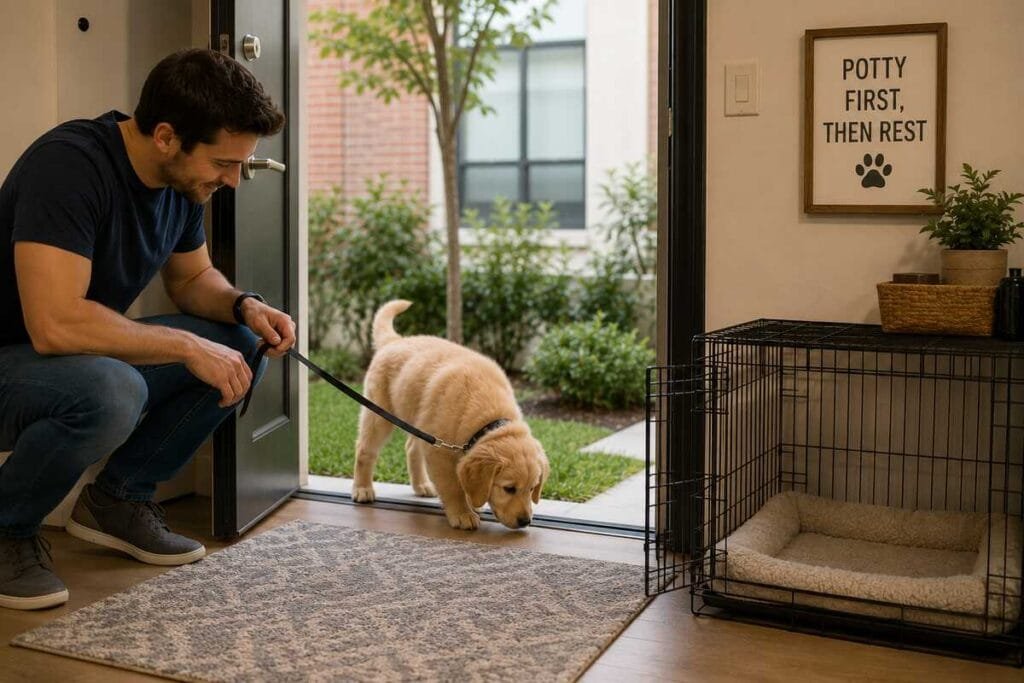
- Always offer a potty break immediately before crating, even if your puppy just went a short while earlier. This small step prevents the majority of avoidable accidents.
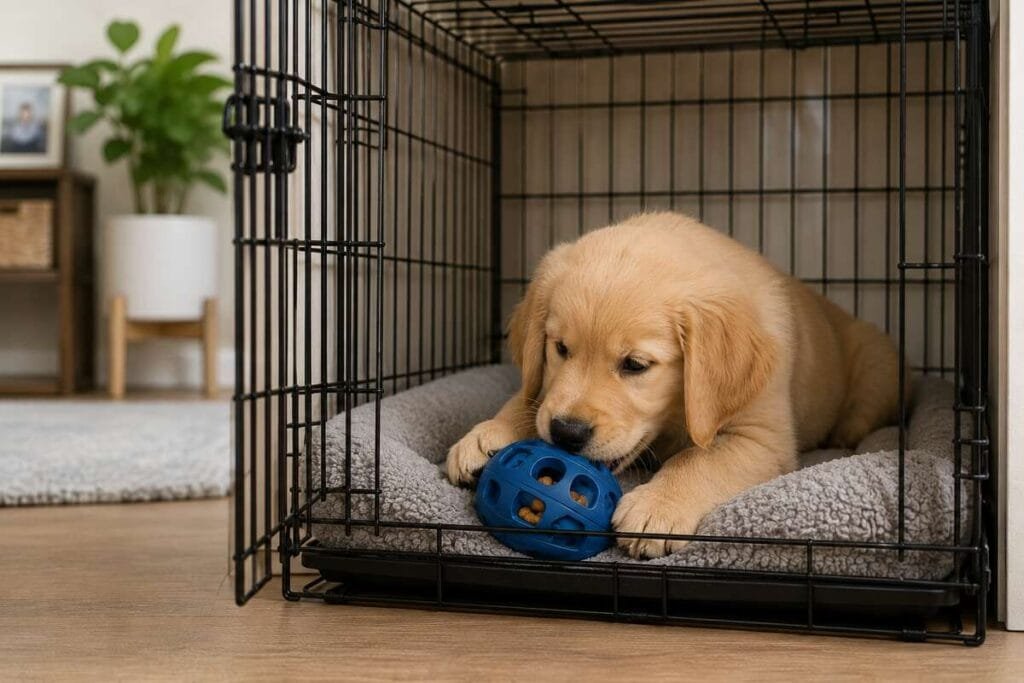
- Add a safe chew toy or food puzzle to keep your puppy occupied during the stretch, which also helps build a positive association with crate time itself.
- Use consistent positive reinforcement, such as calm praise or a small treat, when your puppy enters the crate willingly. Avoid making a big emotional exit or return, since overly excited greetings can actually increase anxiety around your absence.
If your puppy is new to the crate, start with our guide on how to crate train a puppy.
Common Crate Training Mistakes
- Crating a puppy for longer than their current age allows. This is the single most common mistake, and it usually comes from applying an adult dog’s schedule to a puppy who simply is not ready for it yet.
- Using the crate as a punishment. Sending a puppy to the crate after unwanted behavior teaches them to fear the space, which undoes the positive association you are working to build.
- Skipping potty breaks before crate time. Even a quick trip outside right before crating significantly lowers the chance of an accident during the stretch that follows.
- Under exercising a puppy before a long crate stretch. A puppy with pent-up energy is far more likely to struggle with a long crate period than one who has already had a chance to play and explore.
- Keeping an inconsistent daily routine. Puppies settle into crate time more easily when meals, walks, and crate stretches happen at roughly the same times each day.
Many of these same patterns show up in general potty training struggles too. Our puppy potty training mistakes article covers the broader list, and if your puppy specifically has accidents inside the crate itself, our puppy pooping in crate at night guide walks through the most common causes.
Alternatives When You Must Leave Longer
- An exercise pen, which gives more room than a crate while still containing your puppy safely, often large enough to include a small potty pad section.
- A puppy-proofed room with pads or a portable potty setup, useful for puppies who need more space to move during long stretches.
- A dog sitter who can check in partway through the day for a potty break and short play session.
- A dog walker for a reliable midday break, quick exercise, and a chance to stretch outside the crate.
- A trusted family member or neighbor who can pop in during a long workday, especially helpful during the earliest weeks home.
- Doggy daycare a few days a week, which also supports early socialization alongside the practical benefit of a shorter crate stretch.
These options work well as a bridge during the early months when your puppy’s bladder control has not yet caught up with your schedule. Many owners combine two or three of these depending on the day of the week.
Vet Tips
Safe Crate Size
The crate should be large enough for your puppy to stand, turn around, and lie down comfortably, but not so large that they can use one corner as a bathroom space. For growing puppies, a crate with an adjustable divider panel works well, since it lets you expand the usable space gradually as your puppy grows instead of buying a new crate every few months.
Water Guidance
Most veterinarians recommend removing water access an hour or two before bedtime to reduce overnight accidents, while keeping regular access during the day. Puppies should never be denied water for extended periods during waking hours, even if you are trying to manage a longer daytime crate stretch.
Bedding
Use washable, chew-safe bedding, and avoid anything with loose stuffing that could become a choking hazard for young puppies who explore with their mouths. If your puppy tends to chew bedding, a simple washable mat is often a safer choice than a plush bed until that habit passes.
Temperature
Keep the crate in a room with stable, comfortable temperature, away from direct sunlight or drafts that could cause overheating or chilling. A crate placed near a window that gets strong afternoon sun can become uncomfortably warm even in a climate controlled home.
Monitoring
Check in on a crated puppy periodically, especially during the early weeks, to catch early signs of distress before they become a larger problem. A baby monitor or pet camera can be a helpful low effort way to check in without physically disturbing your puppy’s rest.
Crate time recommendations can vary based on your puppy’s breed, health status, and individual temperament. If your puppy has a medical condition, or you notice unusual signs of distress, it is worth checking with your veterinarian for guidance specific to your puppy’s needs. These ranges reflect common veterinary and professional dog training guidance rather than a single rigid rule that applies identically to every puppy.
Frequently Asked Questions
At what age should you stop crating your puppy?
Most owners phase out regular crate use somewhere between 1 and 2 years old, once a dog has demonstrated reliable house manners and bladder control, though many owners choose to keep using the crate as a comfortable resting space well beyond that. There is no strict deadline. Some dogs happily use a crate as their preferred sleeping spot for life, simply with the door left open.
Is it okay if I leave my puppy in the crate for 8 hours?
No. Eight hours is longer than the daytime limit for any puppy. Only adult dogs reach 6 to 8 hours, and they do best with a midday break.
What is the 7-7-7 rule for puppies?
The 7-7-7 rule is a general socialization guideline suggesting puppies be exposed to 7 different environments, 7 different people, and 7 different types of experiences by 7 weeks old. It relates more to early socialization than crate timing specifically, though both areas benefit from a gradual, structured approach that avoids overwhelming a young puppy all at once.
How long can a 12-week-old puppy stay in a crate at night?
Most 12 week old puppies can manage around 4 to 5 hours overnight, often still needing one nighttime potty break. If your puppy is consistently waking you up much earlier than this, it may simply mean they still need that extra break rather than something being wrong with your routine.
Can a puppy stay in a crate while I’m at work?
Young puppies typically cannot handle a full workday alone in a crate. A midday break from a walker, family member, or daycare is usually necessary until your puppy’s age and bladder control catch up. Many owners find that arranging this support for just the first few months makes a significant difference in how smoothly potty training and crate training progress overall.
Can puppies stay in a crate all day?
No. Regardless of age, an entire day in a crate without breaks for exercise, potty trips, and interaction is not appropriate. Even adult dogs benefit from at least one meaningful break during a long day away from home.
How long can a puppy stay in a crate overnight?
This depends heavily on age, ranging from 2 to 3 hours with breaks at 8 weeks old up to a full 7 to 8 hour night by around 5 to 6 months. Keep in mind that individual puppies vary, so use these ranges as a starting point rather than a fixed target.
Can a 4 month old puppy stay in a crate for 7 hours?
No. At 4 months, plan for about 3 hours during the day. A seven-hour stretch is too long for a puppy’s bladder. Arrange a midday potty break.
How long can a 14 week or 16 week puppy stay in a crate?
Plan for about 2 to 3 hours during the day. At night, many puppies this age sleep 5 to 6 hours, and some still need one potty break.
Is it okay to crate a puppy for 11 or 18 hours a day?
No. Even with sleep, that is too long. Puppies need potty breaks, play, and time with people. Spread rest between the crate, a playpen, and family time.
How long should a puppy stay in the crate after not peeing outside?
Keep it short. Many trainers suggest bringing your puppy inside. Keep it in the crate or close by for about 10 to 15 minutes. Then try outside again.
How long can an 8 month old puppy stay in a crate?
Up to about 6 hours during the day, with a potty break before you leave. At night, 7 to 8 hours is common.
Conclusion
Crate time should always match your puppy’s current age and development stage, not your daily schedule. Starting with short, manageable stretches and gradually increasing duration builds a positive relationship with the crate instead of forcing tolerance before your puppy is ready. Every puppy develops at their own pace, so use these ranges as a starting guideline and adjust based on what you observe in your own puppy.
If your puppy already shows separation related stress beyond typical crate adjustment, it may help to look into dog separation anxiety as a related topic.
David Jason is the founder of My Pet Care Tips
David writes practical, research based guides to help pet owners raise healthier, happier dogs and cats. His content focuses on clear, beginner friendly advice backed by trusted veterinary resources and real world pet care best practices.
Last Updated: Oct 10,2026
Sources: American Kennel Club (AKC),ASPCA and American Veterinary Medical Association (AVMA)