
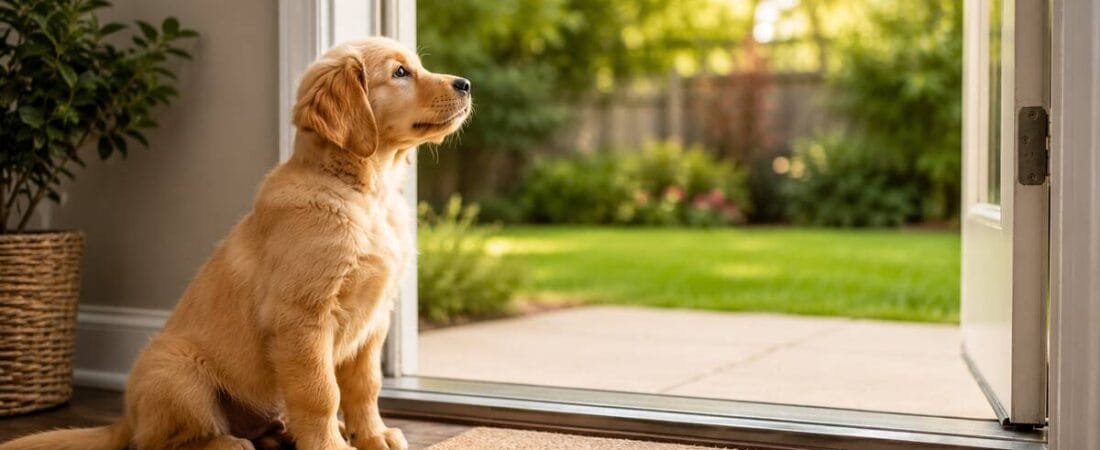
Learning how to potty train a puppy is one of the first real challenges of bringing a new dog home, and it can feel overwhelming when accidents keep happening despite your best efforts. The truth is that potty training follows a fairly predictable process, and most setbacks trace back to a handful of fixable gaps rather than anything wrong with your puppy.
This guide covers everything from when to start to a full step-by-step method, plus answers to the most common questions owners search for, from nighttime accidents to training while you work. Think of it as the hub for everything else on this site related to house training, with links throughout to deeper guides on specific situations, so you can go wide here and dig deeper wherever your puppy needs the most help.
Why Potty Training Matters
Starting early gives your puppy the best chance to build clean habits before bad ones have a chance to form. A well potty trained dog is less stressful to live with, easier to leave alone, and far less likely to develop long-term marking or anxiety-related accidents later in life. It also makes everyday life easier, from having guests over to traveling with your dog down the road.
That said, realistic expectations matter just as much as effort. Most puppies are not fully reliable until somewhere between 4 and 6 months old, and full house training, including nighttime reliability, can take up to a year for some dogs. Progress rarely moves in a perfectly straight line, and the goal is steady improvement over time rather than perfection from week one. Our how to take care of a puppy guide covers the broader daily routine that potty training fits into, which makes this process noticeably easier since feeding, sleep, and exercise all influence how predictable a puppy’s bathroom habits are.
When Should You Start Potty Training a Puppy?
The moment your puppy comes home, usually around 8 weeks old, is the right time to start. Waiting for a puppy to get a little older before beginning actually works against you, since habits start forming with or without guidance, and an unstructured start often takes longer to correct than starting fresh from day one.
- 8 weeks: Bladder control is very limited. Expect frequent accidents even with a good routine, and treat this stage as building the foundation rather than expecting results yet.
- 10 weeks: Control improves gradually. Consistency starts to pay off, and most puppies begin showing early signs of understanding the routine.
- 12 weeks (3 months): Noticeable progress for most puppies with a solid schedule, though occasional accidents are still completely normal.
- 3 to 4 months: Many puppies are mostly reliable during the day, though nighttime can lag behind for several more weeks.
At what age will a puppy be potty trained? Most puppies reach full reliability, including overnight, somewhere between 4 and 6 months, though individual puppies and breed sizes vary, and smaller breeds sometimes take a little longer than larger ones.
What You’ll Need Before You Start
A few basic supplies make the whole process smoother, and having them ready before your puppy comes home avoids scrambling mid-accident:
- A properly sized crate, one that allows standing, turning, and lying down but not much extra room
- A standard leash for supervised outdoor trips, even in a fenced yard
- Small, high-value treats reserved specifically for potty training rewards
- An enzymatic cleaner for accidents, since regular cleaners leave a scent trail behind
- A written or mental schedule to follow consistently, especially during the first few weeks
Step-by-Step Puppy Potty Training Guide
This is the core process for how to potty train a puppy from the very first day, broken into simple steps you can start using right away.
Step 1: Choose One Potty Spot
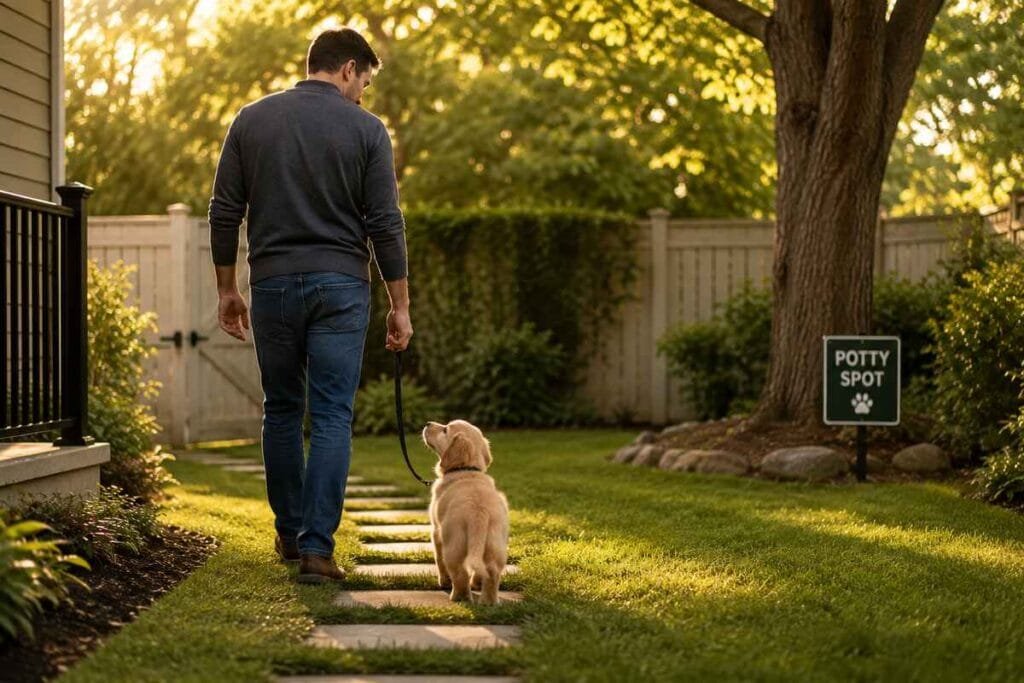
A consistent outdoor spot gives your puppy a scent cue that speeds up learning considerably. Switching locations, or alternating between the yard and a walk, makes it harder for a puppy to connect the spot with the behavior you want.
Step 2: Create a Schedule
Set specific times to go outside rather than waiting for signals alone, especially in the first few weeks. A puppy that only goes outside when it happens to signal will progress far slower than one on a predictable schedule.
Step 3: Take Your Puppy Out After Key Moments
Bathroom breaks should follow waking up, eating, drinking, playing, and naps, every time, without exception early on. These moments are the most reliable predictors of when a puppy will need to go, even more than watching for signals alone.
Step 4: Reward Immediately
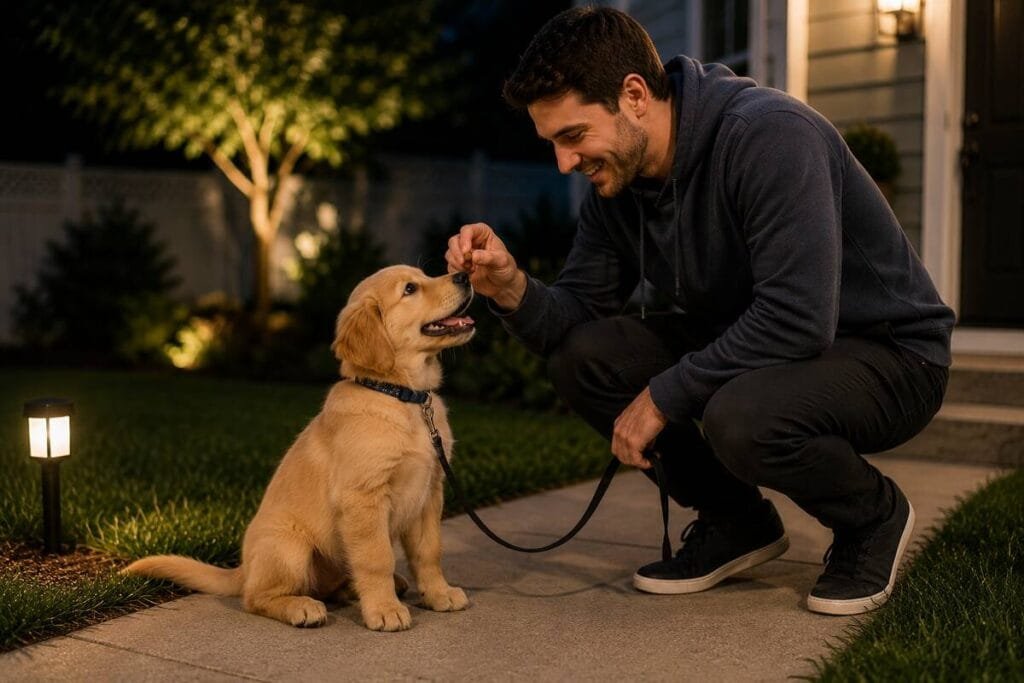
Praise or a small treat within seconds of success reinforces the behavior far more effectively than a delayed reward. Waiting even a minute weakens the connection between the action and the reward in a puppy’s mind.
Step 5: Use a Cue Word
A simple phrase like “go potty” said consistently builds a helpful association over several weeks of repetition. Everyone in the household should use the same phrase to avoid confusing the puppy with mixed signals.
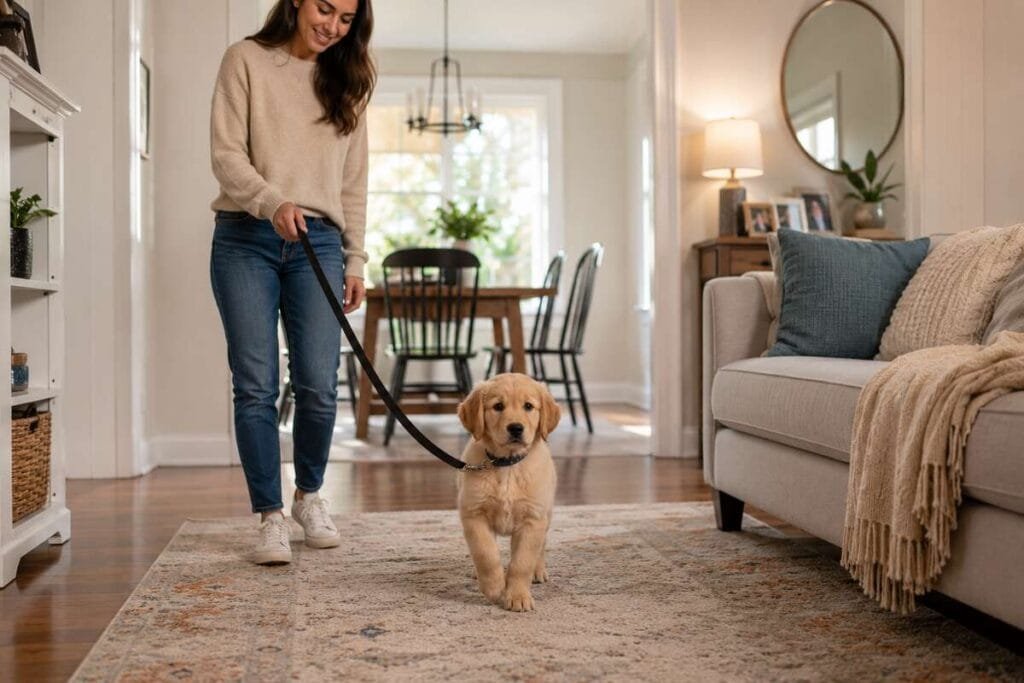
Step 6: Supervise Indoors
Close supervision, or a leash indoors if needed, closes the gap where most accidents actually happen. Unsupervised time indoors is where the vast majority of setbacks occur, especially in the first month.
Step 7: Prevent Accidents Rather Than React to Them
Watching for early signals and acting on them beats catching an accident after the fact every time. Our guide to signs your puppy needs to go potty covers the specific cues worth learning to recognize before an accident happens.
Puppy Potty Training Schedule by Age
A general schedule tightens as your puppy grows, starting with breaks every hour or two at 8 weeks and gradually stretching to every 3 to 4 hours by 5 to 6 months. Our full puppy potty training schedule by age guide breaks this down week by week for every stage.
How Often Should Puppies Go Outside?
| Age | Potty Break Frequency |
|---|---|
| 8 weeks | Every 1 to 2 hours |
| 10 weeks | Every 2 to 3 hours |
| 12 weeks | Every 3 hours |
| 4 months | Every 4 hours |
| 6 months | Every 5 to 6 hours |
How to Potty Train a Puppy Fast
There is no way to skip the process entirely, but a few things speed it up: a strict schedule, close supervision, and immediate rewards every single time. Realistic expectations still matter here. Even with a fast approach, most puppies need several consistent weeks before results feel reliable, and rushing the process by cutting corners on supervision usually backfires with more accidents, not fewer.
How to Potty Train a Puppy to Go Outside
The core of outdoor training is repetition tied to a consistent spot and cue word. Take your puppy to the same area every time, use the same phrase, and reward success immediately so the connection between the spot, the cue, and the reward builds quickly. A leash outside, even in a fenced yard, helps keep a young puppy focused on the task instead of wandering off to explore.
How to Potty Train a Puppy at Night
Nighttime training usually needs a slightly different approach than daytime. A consistent bedtime routine, removing water access an hour or two before bed, and a correctly sized crate all help reduce overnight accidents. Some owners set a middle-of-the-night alarm for very young puppies to prevent accidents until natural bladder control catches up, gradually stretching the interval as the puppy grows.
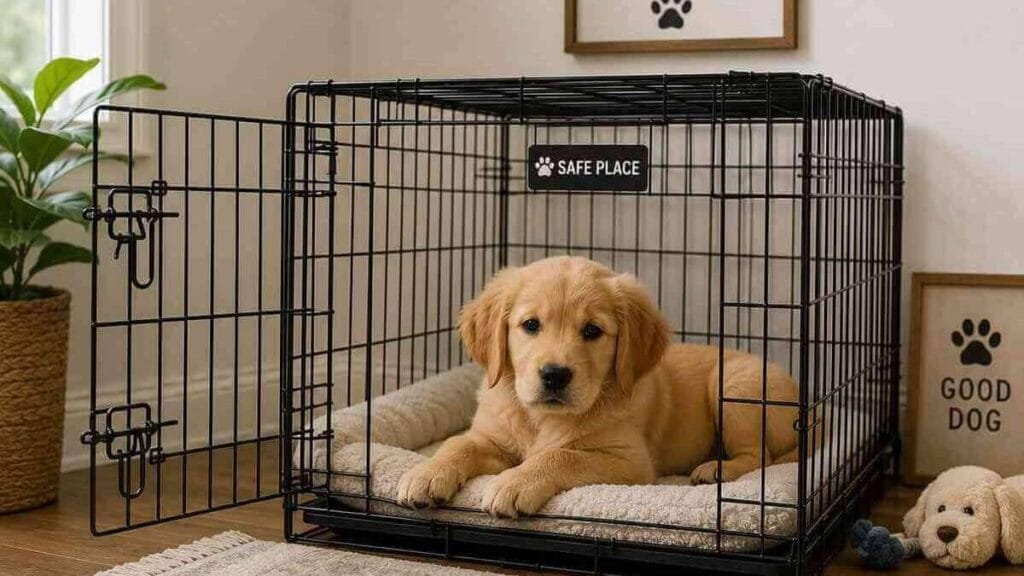
If accidents keep happening specifically overnight, our guide on why is my puppy pooping in the crate at night covers the most common causes and fixes in detail, including situations tied to dog separation anxiety rather than bladder control alone.
How to Potty Train a Puppy While You Work
A full workday is one of the harder scenarios to plan around. A few options help: scheduling a lunch break trip home, hiring a dog sitter or dog walker for a midday visit, or using a secure pen setup with a designated potty area for very young puppies. Whatever the setup, keeping the rest of the daily routine consistent still matters most, since a puppy left alone for long stretches without a midday break is far more likely to have accidents, no matter how good the morning and evening routine looks.
Potty Training in an Apartment
Apartment living adds a few extra considerations, mainly around distance to an outdoor spot and managing stairs or elevators with a puppy that needs to go urgently. A designated indoor area as a backup, faster reaction time to signals, and a realistic plan for middle-of-the-night trips all matter more in an apartment than in a house with a yard. Our dedicated guide on potty training a puppy in an apartment covers the specific adjustments that make this easier.
Potty Pad Training
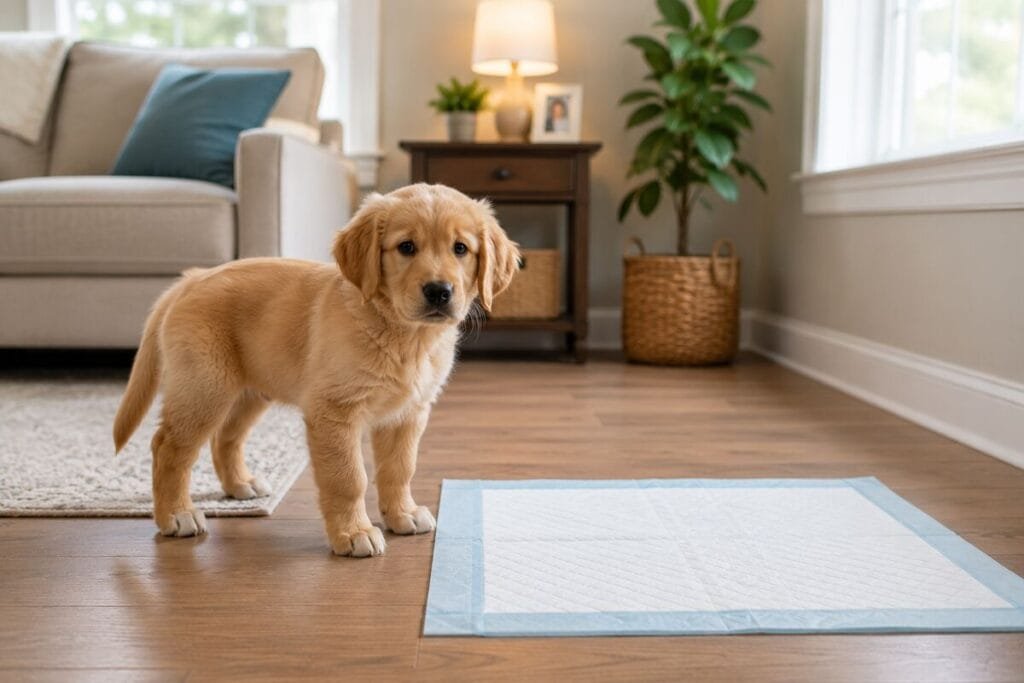
Potty pads can work well for very young puppies, apartment living, or situations where quick outdoor access is not always possible. The tradeoff is a potential extra transition step later if you plan to move to outdoor-only training, since a puppy trained on pads has to unlearn one habit while building another. Deciding early whether pads are temporary or permanent keeps the plan clear and avoids sending mixed signals partway through training. Our full breakdown on puppy potty pads, pros, cons, and when to use them covers this decision in more depth.
Bell Training
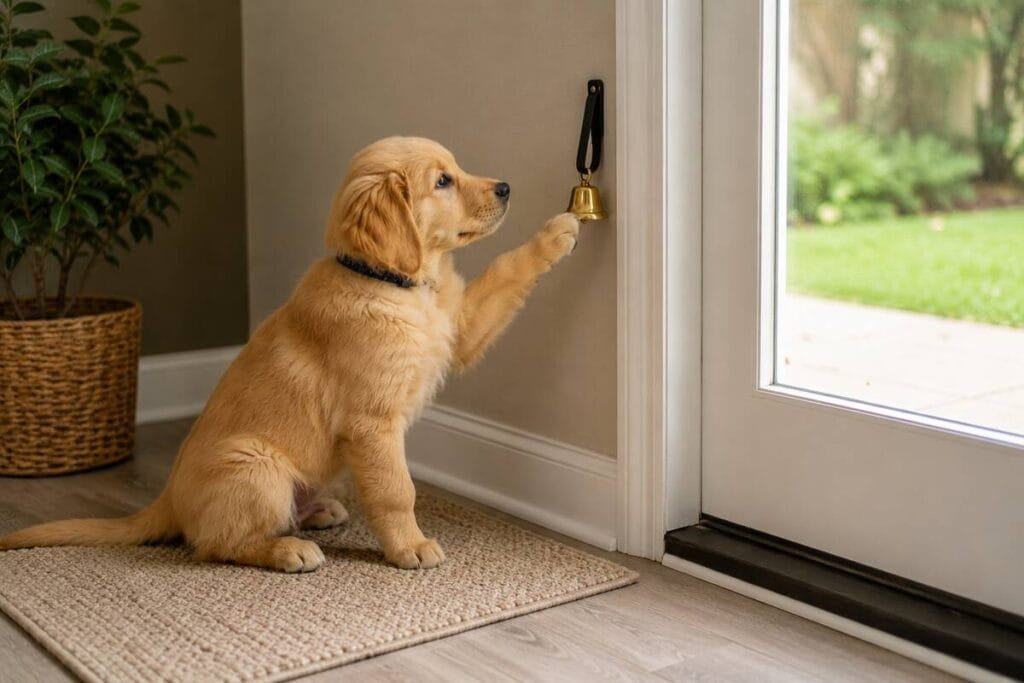
Teaching a puppy to ring a bell by the door gives it a clear, consistent way to signal that it needs to go outside, which can be especially useful for owners who struggle to catch subtler cues like sniffing or circling. It works best paired with a set schedule rather than relying on it alone, since a puppy still needs to learn the connection between ringing the bell and actually going outside to potty. Our guide on bell training your puppy walks through the process step by step.
Common Potty Training Mistakes
A handful of habits quietly slow down even a well-intentioned effort, from punishing accidents to giving too much freedom too soon to using the wrong cleaning products. These mistakes often look like a puppy being difficult when they are really just gaps in the routine. Our full breakdown of puppy potty training mistakes covers all of them in detail, along with the fix for each one.
Signs Your Puppy Needs to Go Potty
Recognizing the early cues, sniffing, circling, restlessness, heading toward the door, is one of the fastest ways to prevent accidents before they happen. Most puppies signal in some way before an accident, but the signs are easy to miss for a first-time owner still learning what to look for. Our guide to signs your puppy needs to go potty covers all 10 common signals in depth, along with what to do the moment you catch one.
Potty Training Regression
Even a reliably trained puppy can suddenly start having accidents again, often tied to growth spurts, adolescence, or a change in routine. This is more common than most owners expect and is usually temporary, resolving within days to a few weeks once the underlying cause is addressed. Our full guide on puppy potty training regression covers the causes and how to fix it without starting the entire process over.
How to Potty Train a Stubborn Puppy
Some puppies simply take longer, often due to breed tendencies, inconsistent routines, or too much freedom too early rather than any real stubbornness. What looks like defiance is usually confusion caused by mixed signals or an unclear schedule. Our dedicated guide on potty training a stubborn puppy walks through a stricter, more structured plan for exactly this situation.
Frequently Asked Questions
What is the quickest way to potty train a puppy?
A strict schedule, close supervision, and immediate rewards every time speed up the process, though there is no way to skip the weeks of consistency it takes. Owners who see the fastest results are usually the ones who stick to the schedule even when it is inconvenient.
What is the 10-10-10 rule?
Take your puppy outside, wait about 10 minutes for it to go, reward within 10 seconds of success, then allow about 10 minutes of supervised freedom before returning to a confined space. It is a simple way to reinforce success quickly without giving too much unsupervised time.
How long does potty training take?
Most puppies show real progress within a few weeks, with full reliability, including overnight, often landing somewhere between 4 and 6 months. Some puppies take longer, and that alone is not usually a cause for concern.
At what age will a puppy be potty trained?
Most puppies are fully reliable between 4 and 6 months old, though this varies by breed size and consistency at home.
Can a puppy be potty trained in 2 weeks?
Basic progress is possible in 2 weeks with a strict routine, but full reliability almost always takes longer, especially overnight, so treat 2 weeks as a starting point rather than a finish line.
How do I stop my puppy peeing and pooping in the house?
Tighten the schedule, supervise closely indoors, clean accidents with an enzymatic cleaner, and reward every outdoor success immediately. Most indoor accidents trace back to one of these being inconsistent.
How do I potty train a puppy while working?
Plan for a midday break, whether through a lunch trip home, a dog sitter, or a secure pen setup, and keep the rest of the daily schedule as consistent as possible even on busy days.
Should I use puppy pads?
They can work well for young puppies or specific living situations, but deciding early whether they are temporary or permanent keeps the process clearer and avoids extra confusion later.
Is crate training necessary?
It is not strictly required, but it is one of the most effective tools available, since it uses a puppy’s natural instinct to keep its resting space clean.
Can puppies hold pee overnight?
Very young puppies usually cannot. Most puppies gain the ability to comfortably hold it through a full night somewhere between 4 and 6 months old, with a consistent bedtime routine helping speed that timeline along.
Final Thoughts
Learning how to potty train a puppy takes patience, but the process itself is straightforward once you understand the routine behind it. Stay consistent, reward every success, and remember that setbacks along the way are normal rather than a sign something has gone wrong.
Written by David Jason Founder of My Pet Care Tips
David has spent years helping first-time puppy owners build reliable routines for house training, crate training, and daily care, drawing on real-world experience and trusted veterinary guidance to make the process less overwhelming.
Last Updated: July 28, 2026
Sources: American Kennel Club (AKC), American Veterinary Medical Association (AVMA), VCA Animal Hospitals, Animal Humane Society
Note: Sudden changes in bathroom habits, or accidents alongside pain, blood, or vomiting, always warrant a veterinary check to rule out an underlying medical cause.