

If you have weighed your Golden Retriever puppy three times this week just to make sure they are growing right, you are in good company. The golden retriever puppy growth chart below breaks down what to expect for weight and height at each stage, so you can tell a normal growth spurt from something worth mentioning to your vet.
Golden Retrievers are a medium-to-large breed with real variation between individual dogs, and even between English-standard and American-standard lines. The numbers below are general averages rather than a strict target to hit.
Quick answer: Golden Retriever puppies grow fastest between 2 and 6 months old, often gaining 1 to 2 pounds a week. Most reach adult height by 9 to 12 months, though full weight, chest depth, and coat fill often take until 18 to 24 months to complete.
Golden Retriever Puppy Growth Chart by Age
| Age | Male Weight | Female Weight |
|---|---|---|
| Birth | Under 1 lb | Under 1 lb |
| 1 month | 5-8 lbs | 4-7 lbs |
| 2 months | 15-22 lbs | 13-20 lbs |
| 3 months | 20-28 lbs | 18-25 lbs |
| 4 months | 28-38 lbs | 24-34 lbs |
| 5 months | 35-45 lbs | 30-40 lbs |
| 6 months | 44-55 lbs | 40-50 lbs |
| 9 months | 55-65 lbs | 48-58 lbs |
| 12 months | 60-75 lbs | 50-65 lbs |
| 18 months | 65-80 lbs | 55-65 lbs |
| Adult (18-24 months) | 65-80 lbs | 55-65 lbs |
At full maturity, adult height generally falls between 23 and 24 inches at the shoulder for males, and 21.5 to 22.5 inches for females, according to the American Kennel Club breed standard.
Why Golden Retriever Puppies Grow So Fast
Most Golden Retriever puppies gain somewhere between 1 and 2 pounds a week during their fastest growth stretch, roughly 2 to 6 months old. That pace is why a 20-pound puppy at 3 months can be pushing 50 pounds by 6 months.
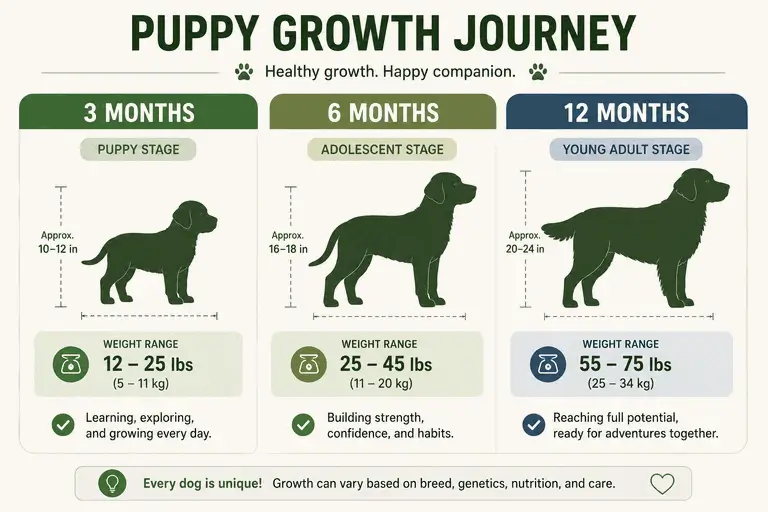
One quirk worth knowing about this breed: female Golden Retriever puppies often grow faster and look bigger than males during the early months, before males eventually catch up and surpass them in final adult size. This can be confusing if you are comparing your puppy to a friend’s dog of the opposite sex.
Growth slows noticeably after 6 months, though it does not stop completely. Most Goldens reach close to their adult height by 9 to 12 months, but chest depth, muscle, and full coat can keep developing until 18 to 24 months.
When Do Golden Retrievers Stop Growing?
Height is usually close to final by 9 to 12 months old for most Golden Retrievers. Weight and overall body fill, however, often continue increasing until somewhere between 18 and 24 months.
A 1-year-old Golden Retriever frequently still looks a little lean and gangly compared to their fully filled-out 2-year-old self. Genetics play a significant role here too, with English-standard lines often running slightly smaller and stockier than American-standard lines at full maturity.
Exercise Guidelines While Your Puppy Is Growing
A widely used guideline for this stage is about 5 minutes of structured exercise per month of age, twice a day, until your puppy is closer to fully grown. Free play in a secure yard is generally fine at any age, since puppies tend to self-regulate better during unstructured play than during a forced walk.
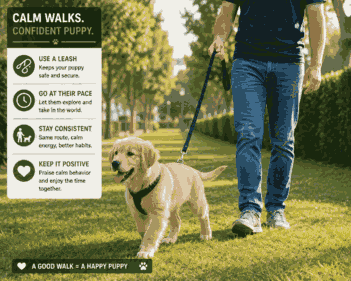
Avoid repeated jumping, forced running, or long hikes on hard pavement while your Golden Retriever puppy is still developing. Peer-reviewed research on large breed puppies has linked rapid growth and excess weight during this window to a higher risk of hip and elbow problems later in life, which is exactly why keeping structured activity conservative matters so much during puppyhood.
Feeding Your Golden Retriever Puppy for Healthy Growth
Overfeeding a fast-growing Golden Retriever puppy does not produce a bigger, healthier adult. It mainly adds extra stress to developing joints, which is why free-feeding puppy kibble is generally discouraged for this breed.
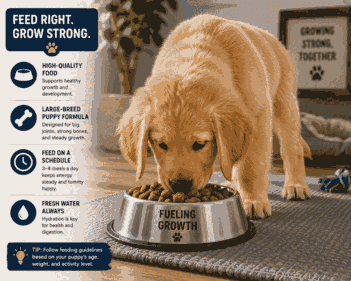
A large-breed puppy formula with controlled calcium levels supports steady, even development. Most puppies do well on 3 meals a day until around 6 months, then a switch to 2 meals a day afterward. Checking body condition by feeling for ribs with light pressure is a far more reliable guide than chasing an exact number on the scale.
Spaying and Neutering: Why Timing Matters More for This Breed
This is worth flagging specifically for Golden Retrievers. A widely cited study from UC Davis found an association between neutering before one year of age and an increased risk of certain joint disorders in this breed specifically, more so than in some other large breeds studied alongside it.
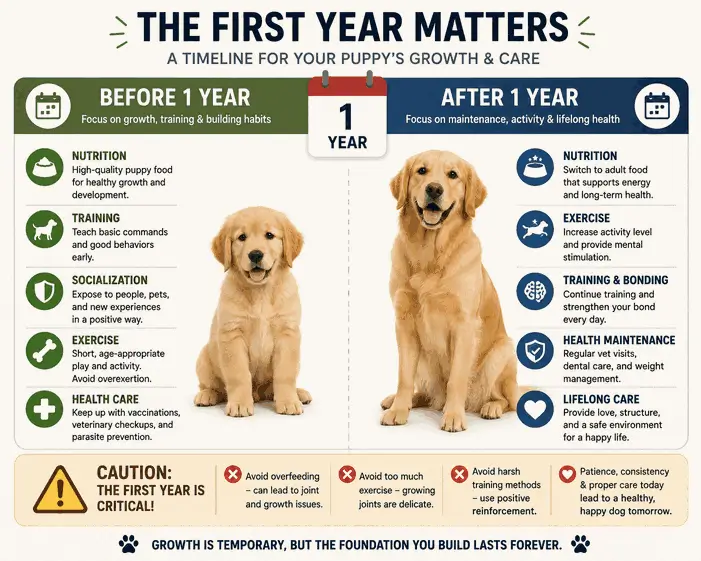
This does not mean early neutering causes problems in every dog, and the right decision depends on your individual puppy, their growth pattern, and your household situation. It does mean this is a conversation worth having directly with your vet rather than following a generic, one-size-fits-all timeline.
How to Tell If Your Puppy Is Growing Normally
Growth rarely follows a perfectly straight line. A few practical ways to check whether your Golden Retriever puppy’s development looks on track include the following.
- Compare current weight to the chart above for their age and sex, allowing for natural variation
- Check body condition by feeling for ribs with light pressure rather than relying on weight alone
- Ask your breeder about the size of the puppy’s parents, since most dogs land close to their parents’ adult size
- Remember that females often grow faster early on before males catch up and surpass them later
When Should You Talk to Your Vet About Growth?
Being somewhat above or below the averages in the golden retriever puppy growth chart above is usually not a concern on its own. A gap of two months or more compared to typical growth patterns, or a puppy that seems consistently underweight, overweight, or in pain, is worth discussing with your veterinarian.
This article is meant as a general guide, not a diagnostic tool. Growth plateaus lasting a couple of weeks are also completely normal and usually just mean your puppy is gearing up for their next growth spurt rather than a sign something is wrong.
If you are also managing your puppy’s exercise needs alongside their growth, our Dog Exercise Routine Guide covers how much daily activity is appropriate as your puppy matures. If you are comparing this breed to another popular retriever, our Labrador Puppy Growth Chart covers a similar first-year journey for that breed.
Frequently Asked Questions
How big will my Golden Retriever puppy get?
Most adult Golden Retrievers fall between 55 and 80 pounds depending on sex and bloodline, with males on the larger end. Height typically ranges from 21.5 to 24 inches at the shoulder.
At what age do Golden Retrievers grow the fastest?
The fastest growth happens between 2 and 6 months old, when puppies often gain 1 to 2 pounds a week.
When do Golden Retriever puppies stop growing?
Most reach adult height by 9 to 12 months, though full weight and body fill can continue until 18 to 24 months.
Do female Golden Retrievers grow faster than males?
Early on, yes. Females often grow faster and look bigger in the first several months before males eventually catch up and surpass them in final adult size.
Is my Golden Retriever puppy underweight or overweight?
Comparing your puppy’s weight to the chart above is a helpful starting point, but body condition, meaning whether you can feel their ribs with light pressure, matters more than an exact number. Ask your vet if you are unsure.
Does neutering timing matter for Golden Retriever growth?
Yes, more so than for some other breeds. Research has linked early neutering, before one year old, to a higher risk of certain joint disorders in Golden Retrievers, so this timing is worth discussing directly with your vet.
Final Takeaway
Your Golden Retriever puppy’s fastest growth happens in the first 6 months, but full development, including chest, coat, and muscle fill, continues well into their second year. Use this golden retriever puppy growth chart as a general guide, watch body condition rather than chasing an exact number, and keep your vet involved for anything that seems off, including spay or neuter timing.
As your puppy grows, breed-specific guidance on shedding, training, and temperament will help you navigate the rest of their first year. Our When Does a Golden Retriever Puppy Start Shedding?, Golden Retriever Puppy Training Tips for First-Time Owners, and complete Golden Retriever Puppy: Complete First-Year Guide cover what comes next. For families weighing this breed against others, our Best Dog Breeds for Families guide is a useful comparison.
Author Bio
David Jason is the founder of My Pet Care Tips and writes practical, research based guides to help pet owners raise healthier, happier dogs and cats. His content focuses on clear, beginner friendly advice backed by trusted veterinary resources and real world pet care best practices.