

Puppy socialization means teaching your puppy that different parts of everyday life are safe and normal. It involves exposing your puppy to various people, animals, sounds, places, surfaces, handling, objects, and movement in calm, positive ways. Socialization is one of the most important things you can do for your puppy’s development, yet many owners think it only means meeting other dogs. The truth is that socialization covers a much wider range of experiences that shape your puppy’s confidence and comfort throughout life.This puppy socialization checklist gives you 100 specific, practical experiences organized into categories that you can work through gradually with your puppy.
The goal is not to rush through all 100 items quickly, but to provide a structured guide for building your puppy’s confidence over weeks and months. Quality matters far more than quantity. A few calm, positive exposures are more valuable than overwhelming your puppy with too many experiences at once.
For more comprehensive guidance on the socialization process by age, see How to Socialize a Puppy: Complete Age-by-Age Checklist.
What Is Puppy Socialization?
Puppy socialization is the process of exposing your puppy to different people, animals, sounds, places, surfaces, handling techniques, objects, and everyday movement in ways that teach your puppy these things are normal and safe. A well-socialized puppy becomes a confident, adaptable adult dog that can handle new situations without fear or aggression.
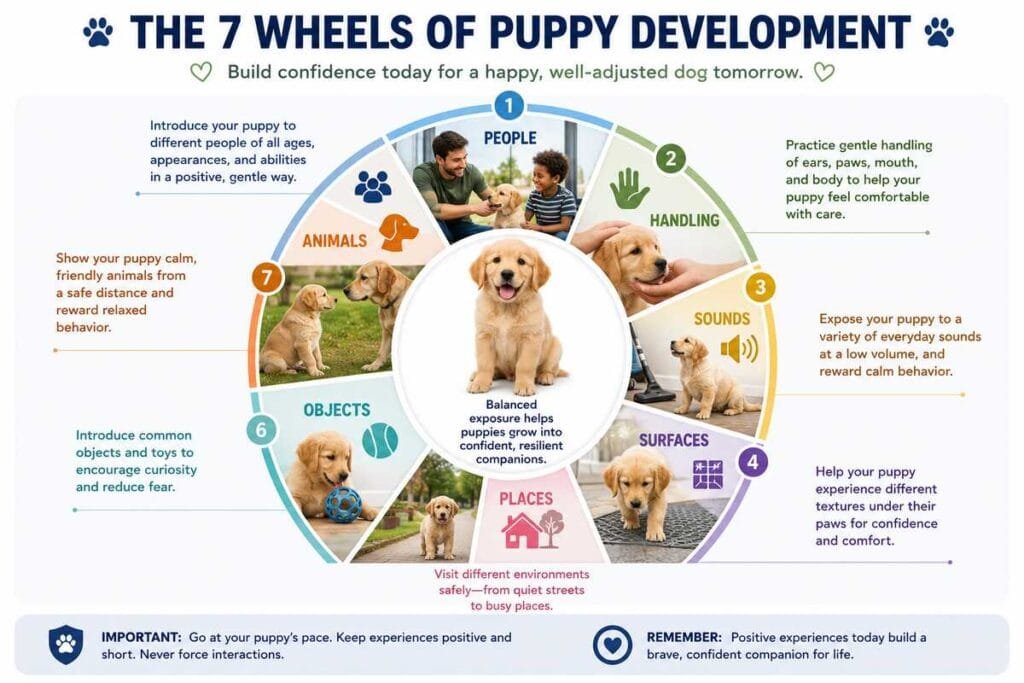
Socialization Is More Than Meeting Other Dogs
Many owners believe puppy socialization means introducing their puppy to as many dogs as possible. While meeting other dogs is one part of socialization, it is only one small piece of the picture. A puppy can meet many different dogs but still be uncomfortable with strangers, grooming, car rides, vacuum cleaners, stairs, different flooring types, umbrellas, traffic noise, or being handled by people. Complete socialization means building your puppy’s confidence across all these different categories of experience.
If your puppy becomes nervous around unfamiliar dogs specifically, read our guide on how to help a puppy scared of other dogs.
When Should You Start Socializing a Puppy?
Start early after bringing your puppy home, while following appropriate health precautions for your puppy’s age and vaccination status. The most critical window for socialization falls between 8 and 16 weeks of age, when puppies are naturally curious and less likely to develop lasting fears. However, positive exposure should continue throughout your puppy’s entire life. Do not rush through the checklist trying to complete all items in a few weeks. Spreading experiences over several months builds more solid confidence than rapid-fire exposure.
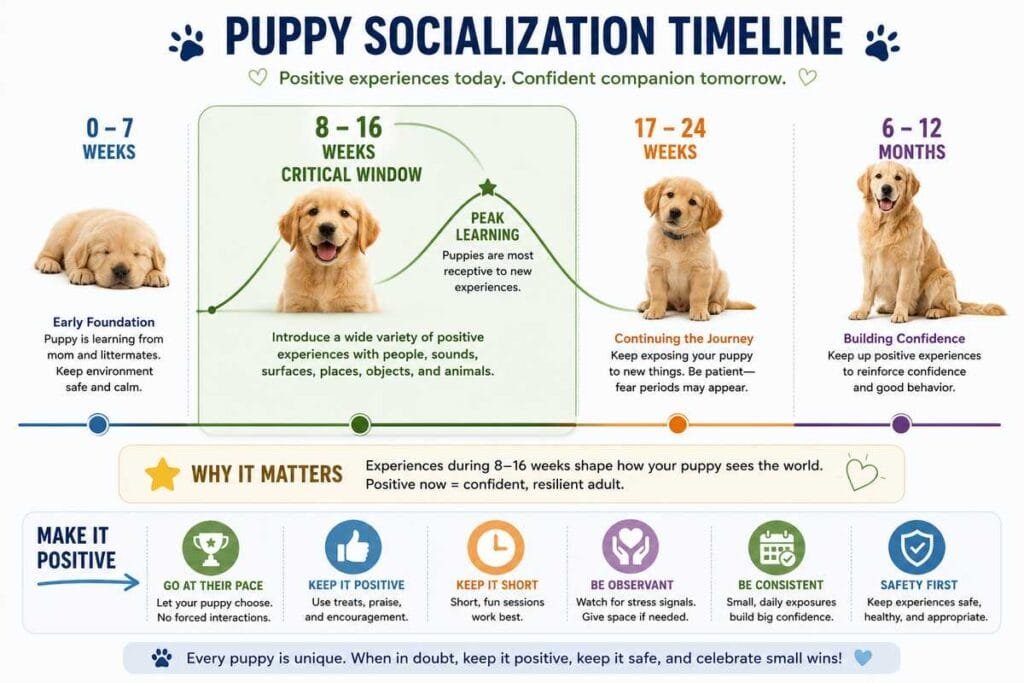
How Many Socialization Experiences Should a Puppy Have Each Day?
There is no rigid number. A few calm, successful experiences per day are far better than overwhelming your puppy with constant novelty. Always follow your puppy’s body language and comfort level. Some days your puppy might be ready for three new experiences, while other days one or two is the right amount. Quality and the puppy’s emotional state matter much more than hitting a specific number.
How to Use This Puppy Socialization Checklist
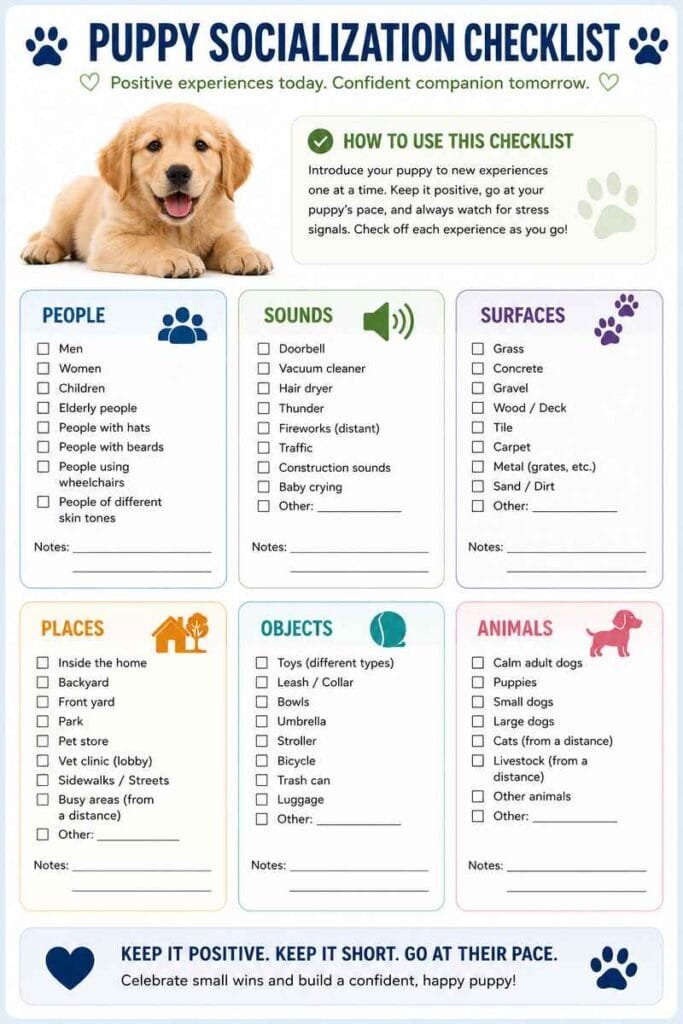
This checklist is designed to be practical and actionable, not overwhelming. Here is how to use it effectively:
Choose only a few items at a time. Do not try to work through multiple new items every day. One or two new experiences every few days is a good pace for most puppies.
Start with easy experiences. Begin with items that are naturally less intense-meeting friendly people at home is easier than encountering crowds in public. Progress to more challenging experiences as your puppy gains confidence.
Keep exposure short. A 5 to 10 minute introduction to something new is usually plenty. Long exposure can overwhelm rather than build confidence.
Pair new experiences with treats, play, or praise. Every new experience should feel rewarding to your puppy. Use high-value treats and happy, calm praise to create positive associations.
Give your puppy space. Do not force your puppy to approach or touch something scary. Allow your puppy to investigate at its own pace and control the distance.
Don’t force interaction. If your puppy shows fear or hesitation, simply move away and try again another day at a lower intensity.
Mark completed experiences. Use the printable checklist to mark off items your puppy has experienced. Seeing progress is motivating and helps you stay organized.
Repeat important experiences in different contexts. Meeting one person is a start, but meeting many different people in various settings builds more robust confidence.
What Counts as a Successful Socialization Experience?
A successful socialization experience includes these elements:
- Your puppy notices the new thing (sees, hears, or approaches it)
- Your puppy remains reasonably relaxed (no extreme fear, trembling, or panic)
- Your puppy can take treats or play normally
- Your puppy can move away if uncomfortable
- Your puppy recovers normally afterward without lingering fear
A puppy does not need to love every experience to count it as successful. Simply noticing something and remaining calm while nearby is a successful start.
Puppy Socialization Checklist – 100 Things to Expose Them To
1. People – 20 Experiences
☐ Men with deep voices ☐ Women ☐ Children (ages 5-8) ☐ Teenagers ☐ Elderly people ☐ Person wearing glasses ☐ Person with a beard ☐ Person wearing a hat ☐ Person wearing a hood ☐ Person with an umbrella ☐ Person carrying a backpack ☐ Person carrying a large bag ☐ Person in a uniform (mail carrier, police officer) ☐ Person using a cane or walking stick ☐ Person using crutches ☐ Person using a wheelchair ☐ Jogger or runner ☐ Cyclist ☐ Someone speaking loudly ☐ Someone moving unexpectedly or differently
Exposing your puppy to different ages, appearances, clothing styles, and movement patterns prevents your puppy from becoming fearful of specific types of people. Positive interactions with diverse people teach your puppy that humans are generally friendly and trustworthy.
2. Handling, Grooming & Body Touch – 15 Experiences
☐ Ears gently touched and looked inside ☐ Paws touched and held briefly ☐ Nails handled gently ☐ Coat brushed gently ☐ Tail handled gently ☐ Collar area touched ☐ Teeth gently examined ☐ Mouth gently handled ☐ Belly touched ☐ Legs gently handled ☐ Practicing gentle restraint (holding still) ☐ Practicing being lifted safely ☐ Being handled while receiving treats ☐ Different people handling puppy ☐ Being dried with a towel
Regular handling experiences prepare your puppy for grooming, veterinary care, nail trimming, and everyday care. Puppies comfortable with being touched cooperate better during these necessary procedures and are easier to manage throughout their lives.
3. Sounds – 15 Experiences
☐ Vacuum cleaner (at low volume, increase gradually) ☐ Hair dryer ☐ Doorbell ☐ Door closing loudly ☐ Phone ringing ☐ Television ☐ Children playing and laughing ☐ Multiple people talking ☐ Traffic noise (from a safe distance) ☐ Car horns ☐ Construction sounds (from a distance) ☐ Banging of pots and pans ☐ Rain sounds ☐ Thunder sounds at very low intensity ☐ Household appliances (blender, microwave, dishwasher)
Sound desensitization should always begin at very low volumes and progress gradually. Never expose your puppy to frightening sounds at full intensity. Pair sound exposure with treats and praise to create positive associations. Sound sensitivity during puppyhood often leads to ongoing anxiety if not addressed early.
4. Surfaces & Textures – 10 Experiences
☐ Carpet or rug ☐ Hardwood or laminate flooring ☐ Tile flooring ☐ Rubber mat or textured surface ☐ Grass ☐ Concrete or asphalt ☐ Gravel or small pebbles ☐ Sand ☐ Wet surface (puddle or wet grass) ☐ Different household textures (smooth wood, rough surfaces)
Different surfaces build confidence in your puppy’s physical coordination and prevent hesitation about walking on various flooring types. This is especially important for puppies that will live in homes with mixed flooring or spend time outdoors on different terrain.
5. Places & Environments – 15 Experiences
☐ Different rooms in your home ☐ Quiet backyard or outdoor space ☐ Front porch or entrance ☐ Driveway or parking area ☐ Elevator (if relevant to your area) ☐ Stairs (up and down) ☐ Parking area (from a safe location, not near moving cars) ☐ Quiet street (on leash, minimal traffic) ☐ Outdoor café environment (from a safe, controlled distance) ☐ Pet-friendly store (if safe and if puppy’s vaccination status allows) ☐ Veterinary clinic (especially during a friendly visit, not just for medical care) ☐ Grooming environment ☐ Car interior during short drives ☐ Friend or family member’s home ☐ Puppy training class
Environment exposure teaches your puppy that new places are not scary. Public locations should always be discussed with your veterinarian in relation to your puppy’s vaccination status and local disease risk. Avoid high-traffic dog areas until your vet confirms it is safe for your puppy’s age and health.
6. Objects, Movement & Everyday Experiences – 10 Experiences
☐ Umbrella opening near the puppy ☐ Rolling suitcase or luggage ☐ Backpack being worn ☐ Bicycle rolling by ☐ Skateboard (at a safe distance) ☐ Shopping cart (at a safe distance) ☐ Cardboard boxes ☐ Plastic bags moving or rustling ☐ Different types of doors (sliding, hinged, automatic if safe) ☐ People carrying unusual objects (ladder, broom, large item)
Objects and movement that are part of everyday life should be introduced in calm ways. Your puppy needs to learn that these things are normal. Avoid sudden scares or forced exposure-let your puppy observe and approach at its own pace.
7. Other Dogs & Animals – 10 Experiences
☐ Calm, vaccinated adult dog ☐ Friendly puppy (appropriate age and size) ☐ Small dog breed ☐ Large dog breed ☐ Calm dog behind a barrier or gate (safe observation) ☐ Cat from a safe distance ☐ Birds (observed from a distance) ☐ Horses or farm animals (from a safe distance) ☐ Livestock (from a safe distance) ☐ Different animal sounds (recordings or live observation)
Meeting every animal in person is not required for complete socialization. Calm observation from a safe distance counts as a valuable experience. Your puppy learns that other animals exist and are not threats without needing direct contact with every species.
How to Socialize Your Puppy Safely Before Full Vaccination
Socialization should not pause until your puppy’s entire vaccine series is complete. However, disease exposure must be considered thoughtfully. Use controlled, low-risk environments whenever possible. Carrying your puppy while walking around public areas allows visual and auditory exposure without unnecessary ground contact. Meeting healthy, appropriately vaccinated dogs from trusted sources is typically safe for partially vaccinated puppies.
Avoid high-risk dog-traffic environments such as dog parks and public pet stores until your veterinarian says they are appropriate for your puppy’s age and vaccination status. Not sure what your puppy can safely do before completing their vaccines? Read our guide on how to socialize a puppy before fully vaccinated.
For vaccination-specific guidance, the AAHA Canine Vaccination Guidelines note that vaccine recommendations depend on the individual dog’s age, lifestyle, and risk factors.
What If Your Puppy Gets Scared During Socialization?
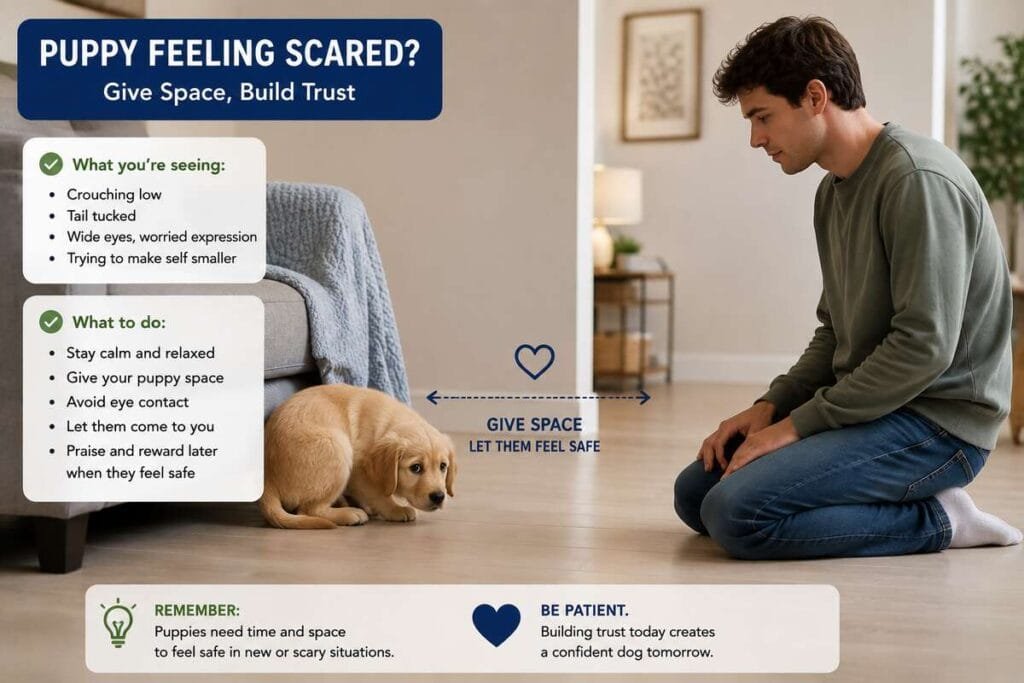
If your puppy shows fear or stress during a socialization experience, the right response is to pause or reduce the intensity immediately. Do not push your puppy to “get over it” by forcing continued exposure.
Stop or reduce intensity. If your puppy is frightened, back away from the scary stimulus and let your puppy settle.
Increase distance. Move your puppy farther away from the thing causing fear until your puppy is calm again.
Let your puppy move away. Never trap or hold your puppy while it faces something scary. Always allow escape.
Don’t force closer. Do not drag or carry your puppy toward a scary stimulus to “introduce” it.
Reward calm observation. If your puppy watches from a distance while calm, reward that behavior.
Keep the session short. End on a calm note before your puppy becomes panicked.
Try again later. Return to easier versions of the same experience in a few days or weeks.
Puppies can also become more sensitive during developmental fear periods. Learn what to expect during the 8 to 11 week puppy fear period. If the fear is specifically around other dogs, read our guide on how to help a puppy scared of other dogs.
Puppy Socialization Mistakes to Avoid
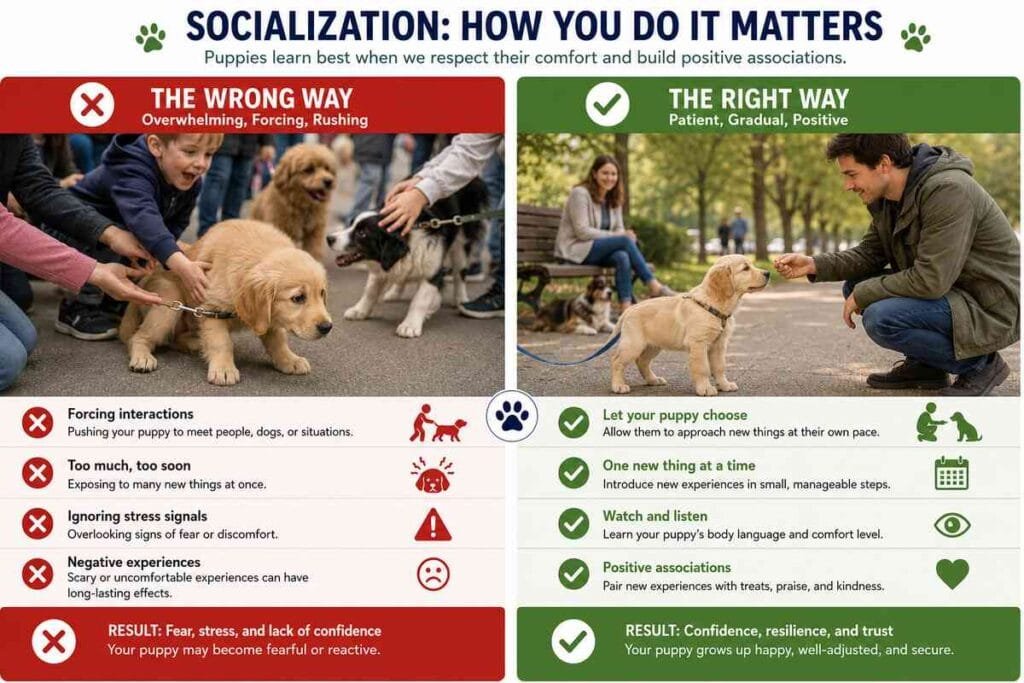
Trying to Complete All 100 Items Too Quickly
Rushing through the checklist defeats the purpose. Spreading experiences over several weeks or months builds more solid confidence than trying to expose your puppy to everything in a few days.
Forcing a Puppy to Approach Something Scary
Forcing a scared puppy toward a scary stimulus can backfire and create lasting negative associations. Always let your puppy control distance and pace.
Thinking Socialization Means Constant Dog Play
Some owners believe socialization is only about dogs meeting and playing with other dogs. Dogs meeting means much more than dog play-it includes meeting people, hearing sounds, experiencing different environments, and being handled.
Ignoring Your Puppy’s Body Language
Your puppy’s behavior tells you whether an experience is positive or stressful. Signs of stress include tucked tail, pinned-back ears, trembling, excessive yawning, lip licking, crouching, or attempts to hide. Pause when you see these signs.
Taking an Unvaccinated Puppy Into High-Risk Dog Areas
Dog parks and areas with many unknown dogs expose your puppy to disease before full vaccination. Stick to controlled environments with known, healthy dogs.
Using Punishment When a Puppy Is Afraid
Scolding or punishing fear makes fear worse, not better. Fear-based behavior requires patience, distance, and positive association, never punishment.
Puppy Socialization Checklist by Age
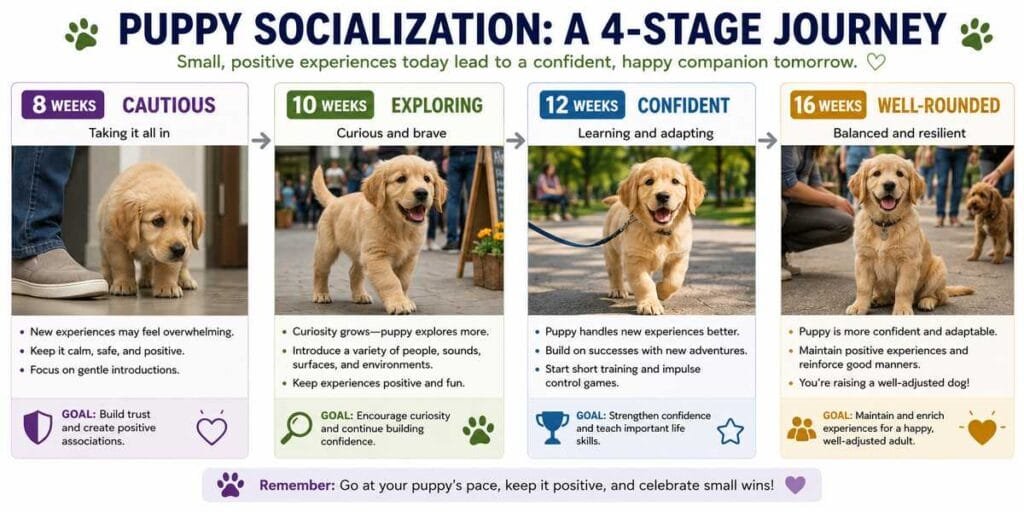
8 to 10 Weeks
Focus on gentle exposure at home and in familiar settings. Introduce your puppy to people you know, household sounds, safe handling, and calm environments. Keep experiences short and positive. This is the beginning of the critical socialization window.
10 to 12 Weeks
Gradually expand exposure to more people and environments. Introduce appropriate puppy classes with other vaccinated puppies. Expose your puppy to more sounds and different surfaces. Continue repeating experiences from the earlier weeks in new contexts.
12 to 16 Weeks
Progressively broaden experiences according to your veterinarian’s guidance on your puppy’s vaccination status. Increase exposure to new environments, sounds, and controlled social encounters. Continue repetition of earlier experiences in different settings to build confidence.
After 16 Weeks
Socialization does not stop at 16 weeks. Continue introducing your puppy to new experiences throughout puppyhood and into adulthood. A puppy fully vaccinated can explore more environments, but the principle of calm, positive exposure remains constant.
Printable Puppy Socialization Checklist
Use this condensed checklist to track your puppy’s progress:
People ☐ Met different ages of people ☐ Met people with different appearances ☐ Met people in different clothing/gear
Handling & Grooming ☐ Paws handled ☐ Ears touched ☐ Mouth handled ☐ Brushed ☐ Practiced restraint
Sounds ☐ Household sounds ☐ Traffic sounds ☐ Appliance sounds ☐ Outdoor sounds ☐ Loud or unexpected sounds
Surfaces ☐ Hard flooring ☐ Carpet ☐ Outdoor terrain ☐ Wet surfaces ☐ Various textures
Places & Environments ☐ Multiple rooms at home ☐ Outdoor spaces ☐ Quiet public spaces ☐ Vet clinic ☐ Different friends’ homes
Objects & Movement ☐ Moving objects (bikes, carts, etc.) ☐ Opening umbrellas ☐ Rolling luggage ☐ Unusual movements ☐ Doors and gateways
Other Dogs & Animals ☐ Calm adult dog ☐ Different dog sizes ☐ Calm observation of animals ☐ Animal sounds ☐ Different species
Frequently Asked Questions
What should I socialize my puppy to? Socialize your puppy to all the things it will encounter in daily life: people of different ages and appearances, household sounds, various surfaces and places, handling and grooming, objects, movement, and other animals. The goal is to teach your puppy that the world is safe and predictable.
What are the most important puppy socialization experiences? The most important experiences are those your puppy will definitely encounter in daily life. For most puppies, this includes various people, handling for grooming and vet care, household sounds, car rides, and safe outdoor environments. Tailor the checklist to your specific lifestyle.
How many things should a puppy be exposed to each day? There is no specific number. One to three calm, successful experiences per day is ideal for most puppies. Quality matters far more than quantity. Overwhelming your puppy with constant novelty causes stress rather than building confidence.
Can I socialize my puppy before vaccinations are complete? Yes. In fact, puppies should begin socialization before their vaccination series is complete, since the critical window is 8 to 16 weeks. Use controlled, low-risk environments. Consult your veterinarian about safe ways to socialize while protecting your puppy’s health.
Should my puppy meet other dogs during socialization? Meeting appropriately selected dogs is part of socialization, but it is only one part. A puppy that only meets dogs but is never exposed to people, sounds, or environments is not fully socialized. Balance dog meetings with all other categories of experience.
What if my puppy is scared during socialization? Stop the experience, create distance, and let your puppy calm down. Never force a scared puppy closer to the scary stimulus. Try again later at a lower intensity. Fear requires patience and positive association, not punishment or forcing.
Is it too late to socialize a puppy after 16 weeks? The 8 to 16 week period is critical, but socialization should continue throughout your puppy’s life. Puppies can still gain confidence from new experiences after 16 weeks, though it may take longer than during the critical window. Early socialization is always better than late socialization.
Does puppy socialization prevent fear and anxiety? Early socialization significantly reduces the likelihood of developing phobias and anxiety disorders, but it is not a complete guarantee. Individual temperament and genes play a role. Good socialization gives your puppy the best foundation for confidence and emotional resilience.
Final Puppy Socialization Checklist
Complete socialization is a process, not a destination. Do not try to finish this checklist in one week or even one month. Aim for many small, positive experiences spread across several months. Consistency and patience matter far more than speed. Each experience your puppy has without fear builds confidence for the next experience. Over time, your puppy learns that the world is safe, predictable, and full of positive surprises.
As you work through this checklist, remember that your puppy’s comfort and confidence are more important than completing every item. Some experiences will naturally happen as part of daily life. Others you may deliberately create. Either way, each calm, positive exposure contributes to building a confident adult dog.
Author Bio
Written by David Jason Founder of My Pet Care Tips
David has spent years helping first-time puppy owners build reliable routines for house training, crate training, and daily care, drawing on real-world experience and trusted veterinary guidance to make the process less overwhelming.
Last Updated: July 28, 2026
Sources: American Veterinary Society of Animal Behavior (AVSAB), American Kennel Club (AKC), American Animal Hospital Association (AAHA)
Note: Every puppy is an individual. Socialization needs vary based on breed, temperament, and health status. Always consult your veterinarian for personalized guidance on your puppy’s socialization and vaccination timeline.