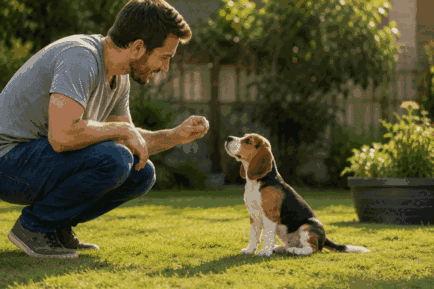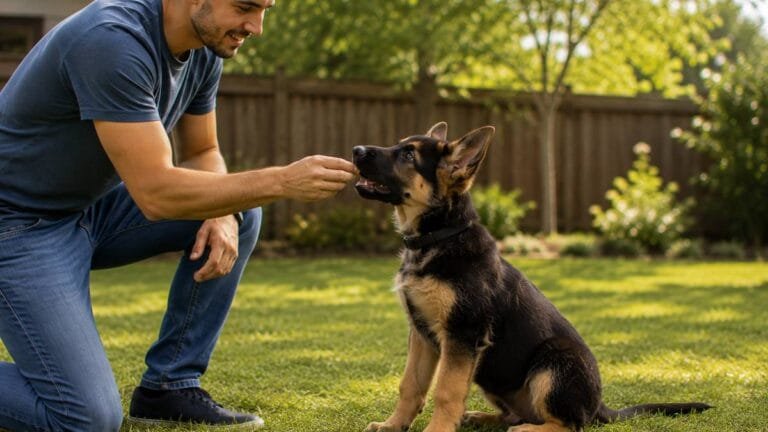

Can you socialize a puppy before all vaccinations are finished? Yes, with a safety plan based on your veterinarian’s advice and local parvovirus risk. The first months are a sensitive time for learning, but socialization does not require crowded dog parks or contact with unknown dogs. A puppy can calmly watch people, traffic and other dogs from a safe distance.
If your puppy is already showing signs of fear around other dogs, read our guide on Puppy Scared of Other Dogs and Puppy Fear Periods: What to Expect at 8–11 Weeks
Can You Socialize a Puppy Before They Are Fully Vaccinated?
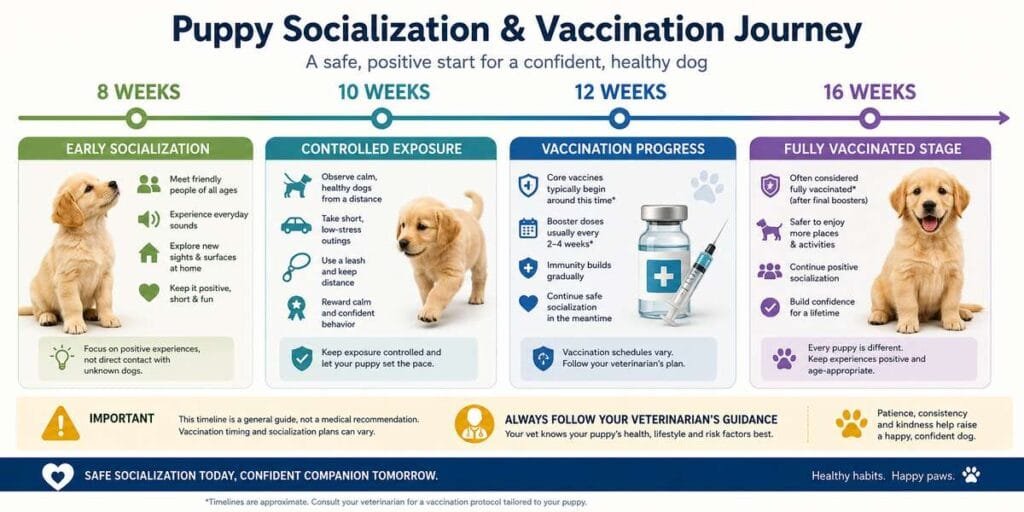
Safe early experiences are encouraged before the vaccine series is complete, provided the puppy’s health, vaccination history and local infection risk are considered. Your veterinarian can help identify suitable environments and puppy classes. Sick puppies or puppies exposed to illness need individual advice.
Why Early Socialization Matters
The first three months are particularly important for social learning, and positive experiences remain useful beyond this stage. Early appropriate exposure may reduce some later fear-related problems, but it does not guarantee an adult dog’s temperament.
A puppy that misses this window often develops fear and avoidance behaviors that are much harder to fix later. Fearful puppies can become reactive dogs that struggle with normal life activities, which impacts their quality of life and your ability to manage them safely.
Why Waiting Too Long Can Cause Fear Later
Puppies that are kept isolated until 16 weeks often have heightened fear responses to novel stimuli. They may become anxious around new people, sounds, or environments even as adults. These fears can be worked through with training and desensitization, but early positive exposure can be helpful, while ongoing training remains possible at later ages.
Why Early Puppy Socialization Is So Important
Early socialization builds the foundation for a confident, well-adjusted adult dog. The benefits extend into every area of your puppy’s life, from training to safety to quality of life.
- Confidence: Puppies exposed to new experiences early develop confidence in unfamiliar situations.
- Prevent fear: Regular, positive exposure prevents phobias and anxiety disorders from forming.
- Reduce aggression: Fear is often the root cause of aggressive behavior, so early socialization helps prevent it.
- Easier training: A confident puppy learns faster and responds better to commands and correction.
- Better adult behavior: Early socialization is one of the strongest predictors of good adult behavior.
- Adaptability: Well-socialized puppies handle change and novelty better throughout their lives.
Puppy Vaccination Timeline and Safe Socialization Stages
Use the vaccination record, not age alone, to plan outings. The AAHA vaccination guidelines emphasize individualized vaccine recommendations, and AVSAB’s puppy socialization statement supports careful early socialization. The following is a risk-planning guide, not a vaccine schedule.
| Health or vaccine status | Examples to discuss with your vet | Important precautions |
|---|---|---|
| Early puppyhood or uncertain vaccine records | Calm experiences at home; viewing people or traffic from a secure carried position | Avoid contaminated ground and contact with unknown dogs. |
| First vaccines received | Controlled exposure in clean locations; screened puppy class if your vet agrees | AVSAB describes classes from about 7–8 weeks, with initial vaccination at least seven days earlier and first deworming; follow the clinic and class requirements. |
| Vaccine series in progress | Continue low-risk experiences selected for the puppy’s needs | Keep vaccines current; do not infer protection from age alone. |
| Series completed, veterinarian has advised on access | Gradually expand appropriate outings | No automatic clearance at 16 weeks; avoid sick animals, hazardous surfaces and overwhelming settings. |
Safe Ways to Socialize an Unvaccinated Puppy
There are many safe ways to socialize a puppy before vaccines are complete. The key is choosing controlled environments where you know the health status of other animals and can manage your puppy’s exposure.
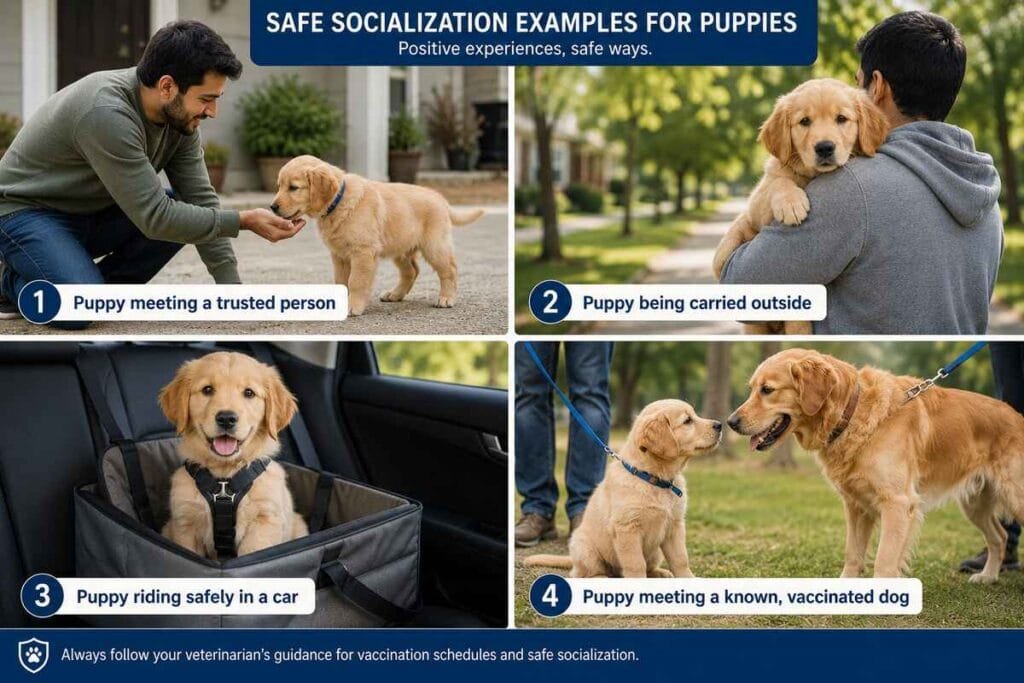
Meet Healthy Vaccinated Dogs
A potential lower-risk option is a brief, supervised visit with a familiar healthy dog in a clean environment, if your veterinarian agrees. Check the other dog’s health and vaccination history and stop if either dog is uncomfortable.
Ask about the other dog’s health, vaccination history and recent exposures. Even a vaccinated dog can carry or become infected with some pathogens. Avoid contact with sick dogs, unknown animals and contaminated ground, and consult your vet about suitable encounters.
Invite Trusted Friends
Inviting people to your home to meet your puppy is one of the safest socialization methods. Your puppy gets to meet new people without exposure to disease risks from public areas or unknown animals. Friends who visit create positive associations with meeting strangers.
Encourage friends to handle your puppy gently, play with it, and give treats. Positive interactions with multiple people build your puppy’s confidence around humans.
Visit Family Members
Extended family visits are excellent for puppy socialization. Your puppy gets to spend time in different homes, meet new family members, and experience different environments safely. Multi-generational exposure helps puppies learn that different people are friendly.
Encourage family members of all ages to interact positively with your puppy. Grandparents, teenagers, and young children all provide different interaction styles that broaden your puppy’s social experience.
Car Rides
Short car rides build confidence and desensitize your puppy to travel. Start with very short trips around the neighborhood, then gradually increase the distance and time. Car rides help your puppy learn that traveling is normal and not scary.
Take trips to positive destinations when possible. A short ride to a friend’s house or a scenic area where your puppy can look out the window teaches that cars lead to good things.
Carry Your Puppy in Public
Carrying your puppy while you walk around shopping areas, parking lots, or neighborhoods gives exposure to crowds, vehicles, and different environments without direct ground contact. Your puppy experiences real-world stimuli while remaining protected from disease risk.
Carry your puppy in your arms or in a puppy carrier so it can observe from a safe vantage point. Let it see and hear traffic, crowds, and interesting sights without direct ground exposure.
Sit Outside Stores
Sitting outside a pet-friendly store or shopping center with your puppy on your lap or in a carrier provides safe exposure to busy environments. Your puppy can watch people, hear different sounds, and experience activity without any risk of contamination from unknown animals.
Choose quieter times initially, then gradually progress to busier periods as your puppy becomes more confident. This teaches that crowds and activity are normal.
Watch Traffic
Watching vehicles from a safe distance (your yard, a sidewalk away from the road) helps your puppy become comfortable with car sounds. Start from farther away and gradually move closer as your puppy adjusts. This is especially important for puppies that will live in areas with regular traffic.
Your puppy learns that the loud sounds of traffic are not scary or dangerous. This prevents later anxiety around traffic.
Meet Different People
Expose your puppy to people of different ages, sizes, and appearances. Invite friends of various backgrounds, elderly neighbors, tall people, people wearing hats, and people with different voices. This breadth of human exposure prevents your puppy from becoming fearful of specific types of people later.
Ensure all interactions are positive and controlled. Reward your puppy with treats and praise when it approaches new people confidently.
Introduce Different Sounds
Play sounds around your puppy during normal household activities. Vacuum, run a blender, listen to music, play videos of thunderstorms or fireworks at low volume, and let your puppy hear doorbells, phones, and other household sounds. Early exposure to noise desensitizes puppies and prevents sound anxiety later.
Keep the volume low initially and gradually increase as your puppy becomes comfortable. Pair sounds with positive experiences like treats or play.
Expose to Different Surfaces
Let your puppy walk on grass, tile, carpet, wood, gravel, and other safe surfaces around your home and yard. Different textures and footing build confidence and prevent puppies from being scared of normal ground variations. Some puppies are nervous on slippery surfaces like tile, so early exposure helps.
Start in familiar spaces and gradually introduce new surface types. Reward your puppy for exploring confidently.
Handling Exercises
Gently handle your puppy’s paws, ears, mouth, and tail daily. Brush it, touch its feet, and get it comfortable with being handled by different people. This preparation is essential for grooming, vet visits, and general care. Puppies that are comfortable with handling are much easier to manage throughout their lives.
Make handling exercises positive with treats and praise. This teaches your puppy that handling is a good thing.
Use Positive Treats and Praise
Every new experience should be paired with positive reinforcement. Reward your puppy with high-value treats, happy praise, and play when it investigates new things or meets new people confidently. This creates positive associations with novelty and builds confidence.
If your puppy shows fear or hesitation, do not force the interaction. Simply move away and try again in a few days. Pushing scared puppies can actually increase fear.
Learn more about positive training in our guide on How to Train a Puppy at Home.
Places That Are Safe Before Your Puppy Is Fully Vaccinated
Risk varies by location and local disease activity. Clean private settings may be suitable, but public dog areas can carry infection risks. Ask your veterinarian before expanding access.
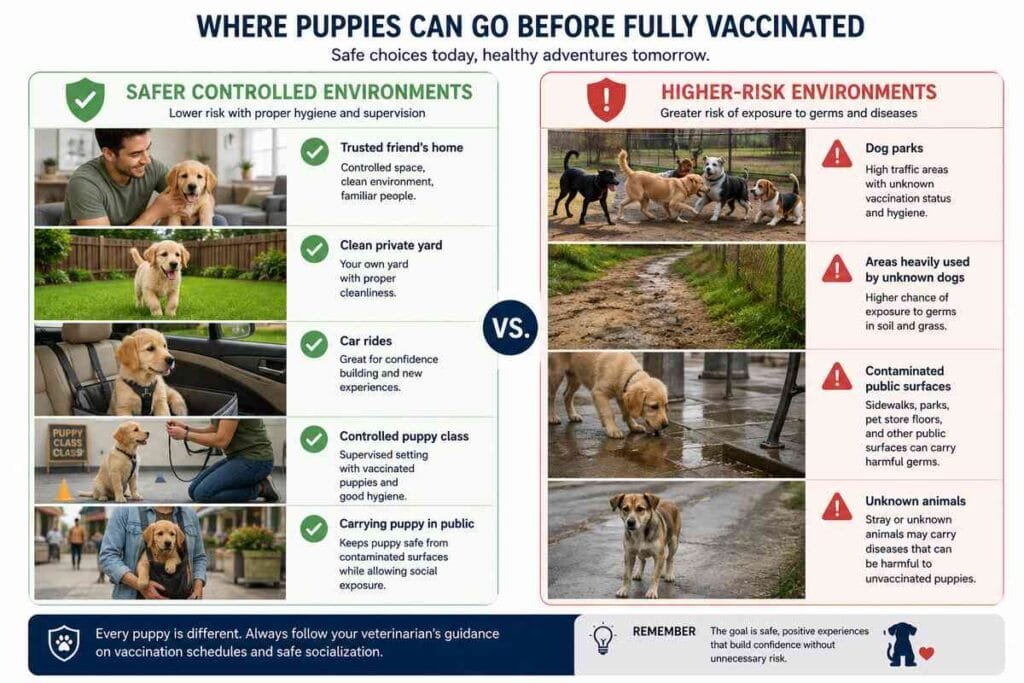
Safe Places for Unvaccinated Puppies
- Your home and yard
- Friend’s house (with vaccinated pets)
- Relative’s yard (known to be clean and safe)
- Carrying your puppy in shopping areas (no ground contact)
- Vet clinic waiting area (if your vet recommends and has separate areas)
- Your car during short drives
- Puppy training class requiring all participants to be vaccinated
Unsafe Places Before Full Vaccination
- Dog parks and off-leash areas
- Public parks and hiking trails with unknown dog traffic
- Pet store floors where many animals have walked
- Dog beaches or swimming areas
- Unknown grass areas or wooded areas with stray animals
- Areas with wildlife like raccoons or opossums that may carry disease
Can an Unvaccinated Puppy Meet Other Dogs?
Yes, but only under specific circumstances with careful selection. Not all dog-to-dog contact is equally risky. The health status and vaccination history of the other dog matters tremendously.
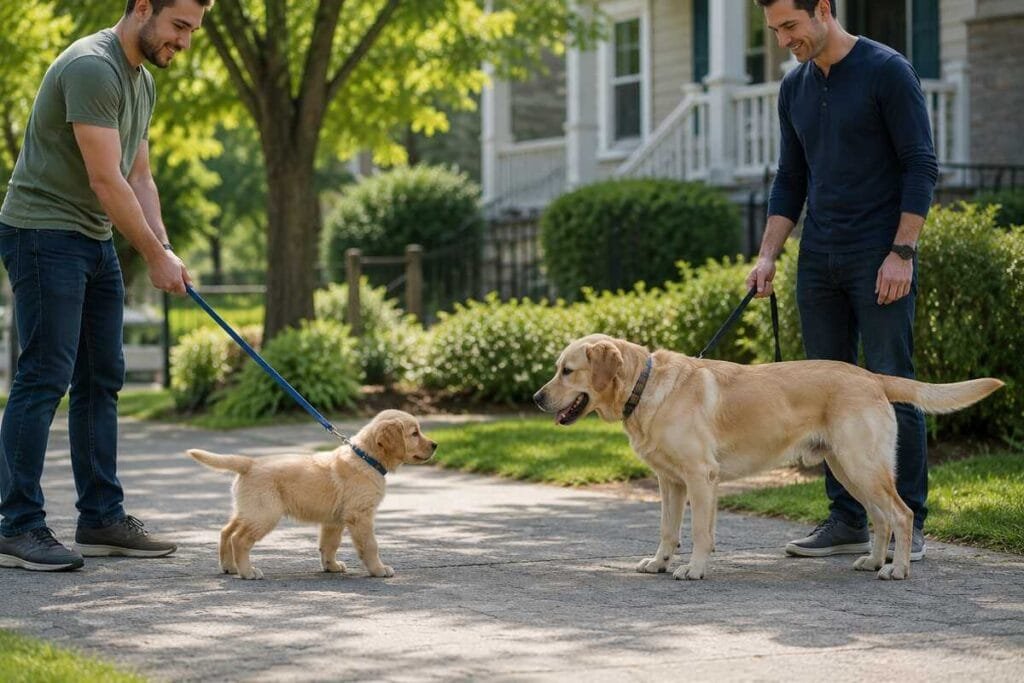
Safe dogs to meet:
- Dogs with confirmed complete vaccination status
- Healthy adult dogs with no signs of illness
- Dogs owned by friends or family whose health practices you know
- Dogs in vet-recommended puppy socialization classes where all dogs must be vaccinated
Dogs to avoid:
- Stray dogs of unknown vaccination status
- Dogs that appear sick or have signs of illness
- Dogs whose vaccination history is unknown or questionable
- Dogs in public dog parks that allow all dogs regardless of vaccination status
If your puppy shows signs of fear around dogs, read our detailed guide on Puppy Scared of Other Dogs.
Puppy Socialization Mistakes to Avoid Before Full Vaccination
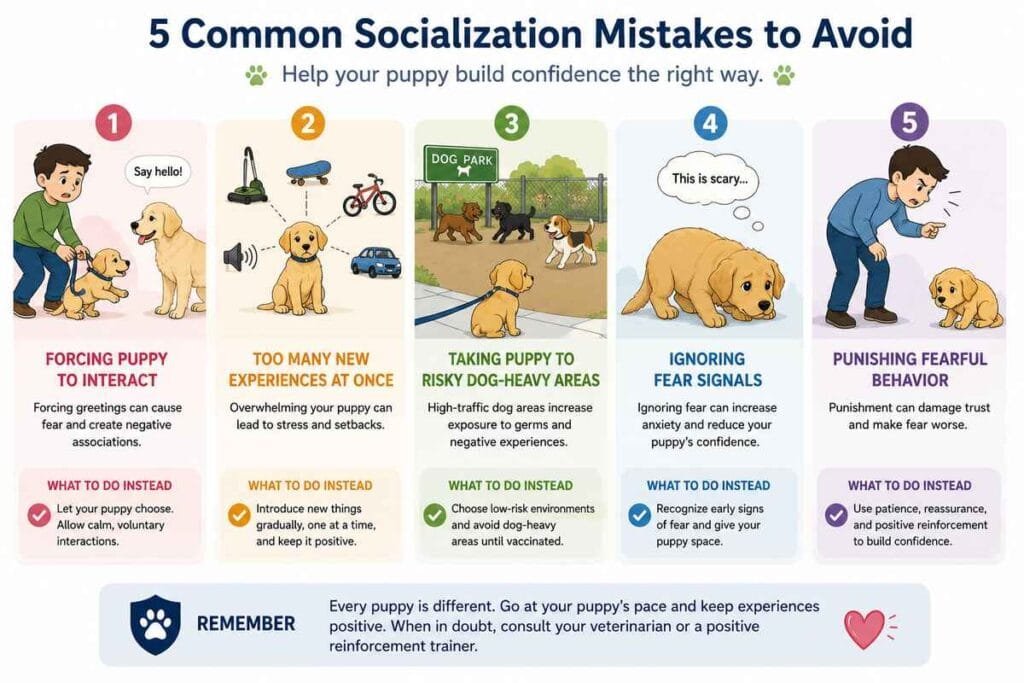
Even well-intentioned owners sometimes make mistakes that harm puppies’ socialization or safety.
- Waiting until vaccines finish: Missing the critical window by being overly cautious means lost opportunity.
- Taking puppy to dog parks too early: Dog parks expose puppies to unknown dogs and potential disease before they’re protected.
- Forcing interactions: Pushing a scared puppy into situations creates negative associations, not confidence.
- Too many experiences at once: Overwhelming your puppy with too much novelty too fast causes stress, not confidence.
- Punishing fearful behavior: Scolding a scared puppy makes fear worse, not better.
- Ignoring stress signals: Missing your puppy’s body language cues means you don’t know when to pause and back off.
How to Know if Your Puppy Is Overwhelmed During Socialization
Learning to recognize stress signals helps you know when to pause socialization and back off.
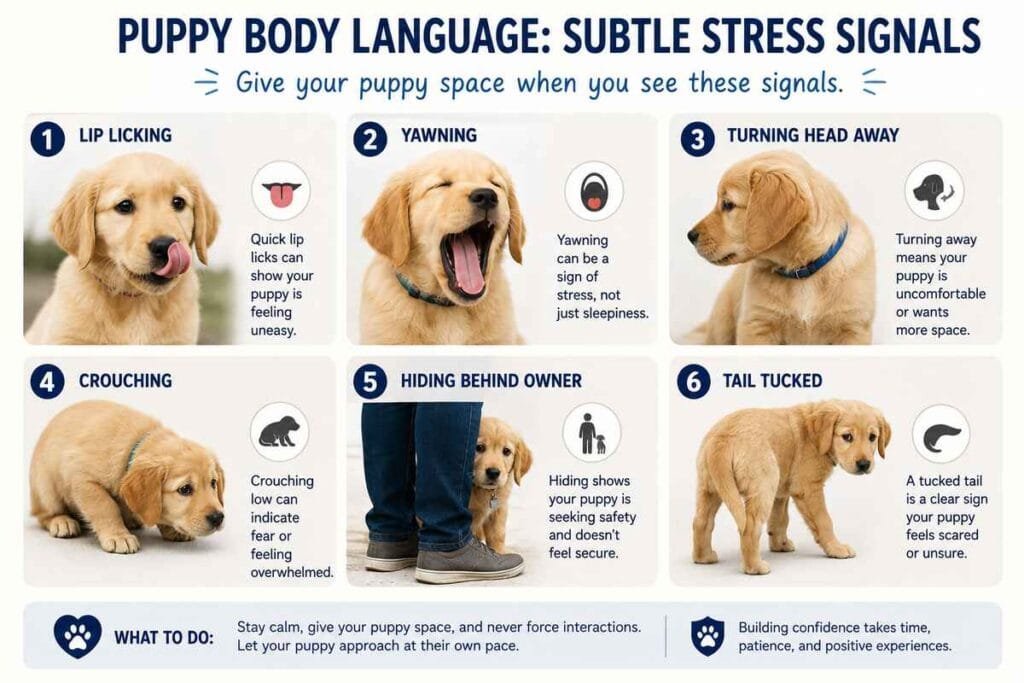
Body Language Signs
- Tucked tail between legs
- Ears pinned back
- Stiff, tense body posture
- Yawning excessively (stress yawn, not tiredness)
- Lip licking or nose licking
- Panting with mouth closed
Fear Signals
- Cowering or freezing in place
- Refusing to move or explore
- Excessive trembling
- Attempting to escape or hide
- Whining or whimpering
When to Stop
If you see any of these signals, stop the activity immediately and move your puppy to a calmer space. Do not force continued exposure. Return to the activity another day at a lower intensity. This teaches your puppy that you understand its signals and respect its comfort level, which actually builds trust and confidence over time.
Weekly Puppy Socialization Checklist
This checklist helps you track which categories of exposure your puppy has experienced each week. Aim to expose your puppy to at least one new thing in each category weekly.
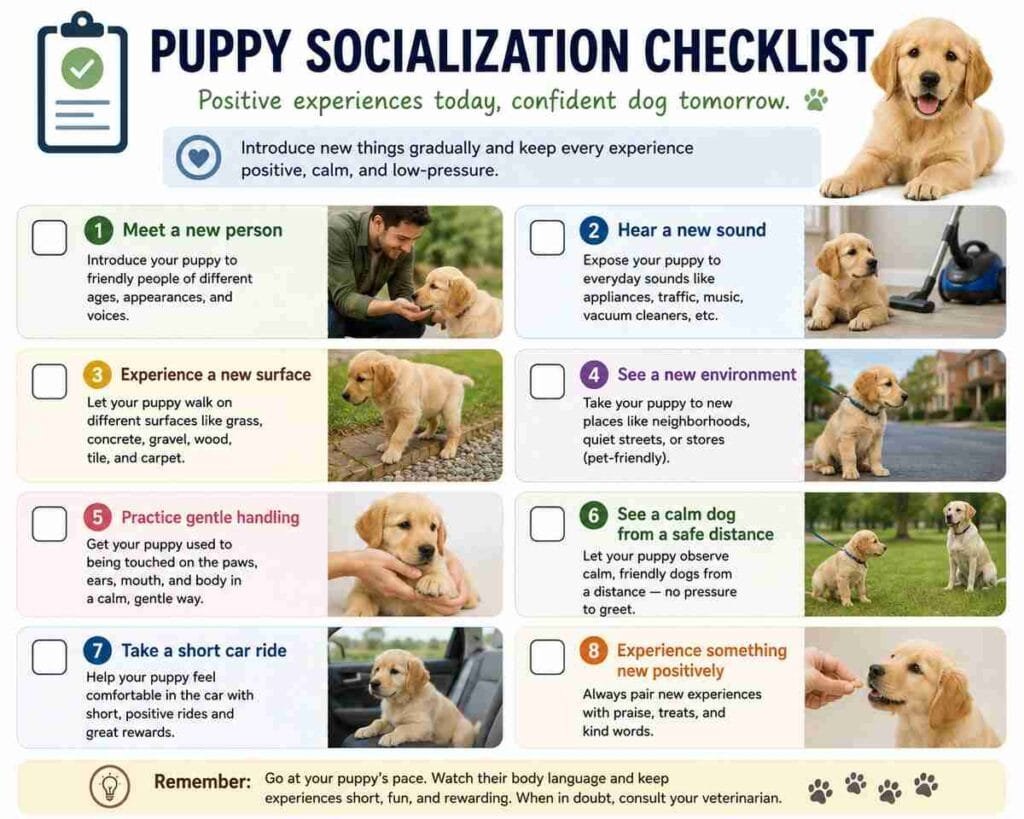
| Category | Week 1 | Week 2 | Week 3 | Week 4 | Notes |
|---|---|---|---|---|---|
| Different people (ages, sizes) | ☐ | ☐ | ☐ | ☐ | Variety is key |
| Vaccinated dogs | ☐ | ☐ | ☐ | ☐ | Positive interactions only |
| Children | ☐ | ☐ | ☐ | ☐ | Gentle interaction |
| Sounds (vacuum, doorbell, etc.) | ☐ | ☐ | ☐ | ☐ | Start quiet, increase volume |
| Vehicles and traffic | ☐ | ☐ | ☐ | ☐ | From safe distance |
| Different surfaces | ☐ | ☐ | ☐ | ☐ | Grass, tile, gravel, etc. |
| Objects (umbrella, hat, toys) | ☐ | ☐ | ☐ | ☐ | Novel items trigger curiosity |
| Gentle handling (paws, ears, mouth) | ☐ | ☐ | ☐ | ☐ | Daily practice |
| New locations | ☐ | ☐ | ☐ | ☐ | Friend’s house, relatives |
| Household noises | ☐ | ☐ | ☐ | ☐ | Blender, washing machine, etc. |
Before-vaccination socialization: a practical US safety checklist
| Situation | Lower-risk option | What to avoid |
|---|---|---|
| People and city sounds | Watch from a clean porch, car or carried position while rewarding calm attention | Uncontrolled crowds and forcing strangers to handle the puppy |
| Dog interaction | Arrange brief contact with a healthy, appropriately vaccinated, friendly dog after veterinary advice | Dog parks, unknown vaccination status and feces-contaminated areas |
| Puppy class | Ask the provider about vaccines, cleaning procedures, class size and local vet recommendations | Classes without health screening or suitable hygiene |
| Fear response | Increase distance, simplify the exposure and stop when your puppy cannot recover | Flooding, leash pulling and repeated forced greetings |
AVSAB supports safe early socialization before the full vaccine series is finished, but the specific environment matters. For example, an apartment-building communal dog relief area may carry a different risk from a private clean space. Ask your local US veterinary clinic which places are safe based on local canine parvovirus activity and your puppy’s vaccination progress.
See our complete puppy socialization method, support for puppies afraid of other dogs and the optional exposure checklist. Compare AVSAB’s socialization position statement and VCA’s puppy socialization guidance.
Frequently Asked Questions
Can puppies socialize before vaccinations?
Yes, with a veterinarian-approved plan. Early puppyhood is an important learning period; choose low-risk experiences that do not require contact with unknown dogs or contaminated ground.
Can my puppy meet vaccinated dogs?
Possibly, if your veterinarian considers the encounter appropriate. A known healthy and appropriately vaccinated dog in a clean setting may be lower risk, but no encounter is risk-free.
Can I carry my puppy outside?
Yes. Carrying your puppy while you walk around public areas is an excellent, low-risk way to expose it to sights, sounds, and people without direct ground contact. This prevents disease exposure while building confidence.
Can puppies visit pet stores?
Most pet stores are not recommended because pet store floors see many animals and carry disease risk. If your vet allows it, carrying your puppy (not on the floor) in a pet store briefly is safer than letting it walk on the floor.
When should puppy socialization begin?
Gentle exposure starts with the breeder or caregiver before homecoming and continues throughout life. AVSAB highlights the first three months, so arrange safe experiences early rather than waiting for all vaccines.
How many experiences should my puppy have each week?
Aim for at least one new experience in each major category (people, sounds, surfaces, environments) each week. More frequent, shorter exposures are better than fewer, longer ones.
When to Call Your Veterinarian
Certain situations warrant veterinary guidance before or after socialization outings. Contact your vet if you notice:
- Signs of illness after an outing (vomiting, diarrhea, lethargy)
- Suspected exposure to an unvaccinated or sick animal
- Severe fear response that doesn’t improve with gentle exposure
- Signs of aggression toward people or other animals
- Extreme anxiety that affects daily functioning
For more information, see our guides on Common Pet Health Problems and Pet Emergency Signs.
Final Thoughts
Socialization starts before your puppy is fully vaccinated, not after. Early puppyhood is an important learning period. Positive, age-appropriate experiences can still be helpful later, so start safely and continue at your puppy’s pace. Keep exposure controlled and positive, avoid truly risky locations, build confidence gradually, and consult your veterinarian when you are unsure about specific situations.
Positive early experiences can build confidence, but they cannot guarantee an adult dog will never become fearful or anxious. Continue manageable positive experiences as your puppy grows.
Related Articles: Puppy Socialization Checklist: 100 Things to Expose Them To and How to Socialize a Puppy: Complete Age-by-Age Checklist.
Editorial information
Published by My Pet Care Tips Editorial Team. This publication byline is not a veterinary qualification or a claim of article-specific veterinary review. We aim to provide clear educational information. Read our Editorial Standards for sources, corrections and review policy; consult a licensed veterinarian for individual medical advice.
Sources: American Veterinary Medical Association (AVMA), American Animal Hospital Association (AAHA), American Kennel Club (AKC)
Note: Every puppy is unique, and socialization needs may vary based on breed, temperament, and health status. Consult your veterinarian for personalized guidance on what is safe for your specific puppy.