

The critical socialization window for puppies happens between 8 and 16 weeks of age, which is exactly when they are not yet fully vaccinated. This timing concerns many new owners who often believe they must wait until vaccination is complete to introduce their puppy to the world. The truth is that puppies need early exposure to people, sounds, environments, and other dogs during this window to prevent fear and behavior problems later. The key is doing it safely without taking unnecessary disease risks.This guide explains how to socialize a puppy before fully vaccinated using vet-approved methods that protect health while building confidence. You’ll learn which places are safe, which dogs are okay to meet, common mistakes to avoid, and how to recognize when your puppy is overwhelmed.
If your puppy is already showing signs of fear around other dogs, read our guide on Puppy Scared of Other Dogs and Puppy Fear Periods: What to Expect at 8–11 Weeks
Can You Socialize a Puppy Before They Are Fully Vaccinated?
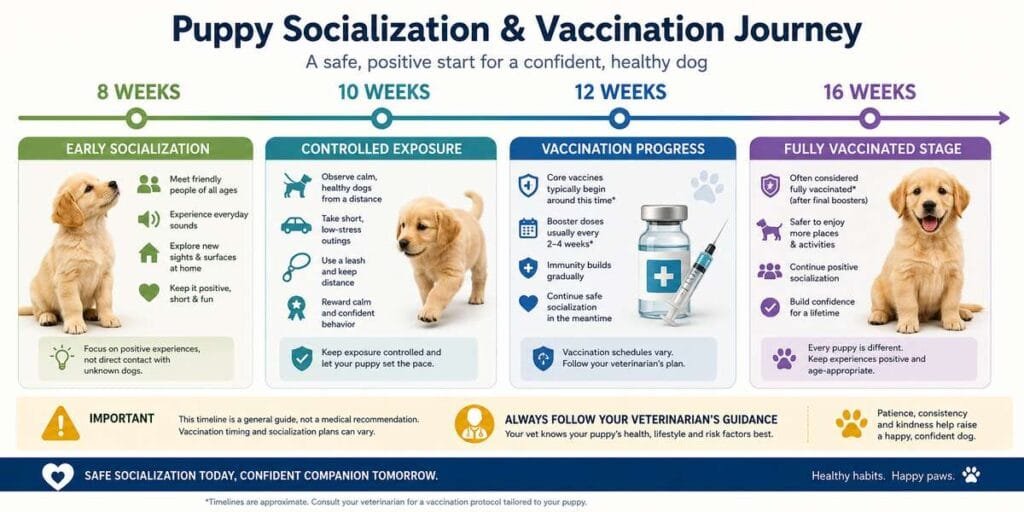
Yes, puppies absolutely should be socialized before their vaccination series is complete. This is not optional. Many new owners wonder how to socialize a puppy before fully vaccinated safely. The answer is that early socialization is one of the most important investments in your puppy’s future behavior and confidence. Waiting until vaccines finish means missing the critical window when puppies are most open to new experiences and least likely to develop lasting fears.
Why Early Socialization Matters
The 8 to 16 week period is called the critical socialization window, and research shows it directly shapes a puppy’s personality and behavior for life. Puppies exposed to a variety of people, sounds, and environments during this window become more confident, adaptable adults. They are also far less likely to develop fear-based aggression or anxiety in new situations.
A puppy that misses this window often develops fear and avoidance behaviors that are much harder to fix later. Fearful puppies can become reactive dogs that struggle with normal life activities, which impacts their quality of life and your ability to manage them safely.
Why Waiting Too Long Can Cause Fear Later
Puppies that are kept isolated until 16 weeks often have heightened fear responses to novel stimuli. They may become anxious around new people, sounds, or environments even as adults. These fears can be worked through with training and desensitization, but prevention through early exposure is always easier than rehabilitation later.
Why Early Puppy Socialization Is So Important
Early socialization builds the foundation for a confident, well-adjusted adult dog. The benefits extend into every area of your puppy’s life, from training to safety to quality of life.
- Confidence: Puppies exposed to new experiences early develop confidence in unfamiliar situations.
- Prevent fear: Regular, positive exposure prevents phobias and anxiety disorders from forming.
- Reduce aggression: Fear is often the root cause of aggressive behavior, so early socialization helps prevent it.
- Easier training: A confident puppy learns faster and responds better to commands and correction.
- Better adult behavior: Early socialization is one of the strongest predictors of good adult behavior.
- Adaptability: Well-socialized puppies handle change and novelty better throughout their lives.
Puppy Vaccination Timeline and Safe Socialization Stages
Understanding your puppy’s vaccination schedule helps you know what level of exposure is safe at each stage. Your veterinarian will provide a vaccination timeline specific to your puppy, but here’s a general guide to what you can safely do at each age.
| Puppy Age | Vaccination Stage | Safe Socialization Activities |
|---|---|---|
| 8 weeks | First vaccines (DHPP) | Controlled indoor exposure, trusted vaccinated dogs, family members, car rides |
| 9–10 weeks | Partial protection building | Trusted vaccinated dogs only, controlled outdoor areas (not parks), carry in public |
| 11–12 weeks | More vaccines (booster) | Increased outdoor exposure, more varied environments, calm public areas |
| 13–15 weeks | Nearly complete series | Most outdoor activities safe except high-traffic dog parks |
| 16 weeks | Fully vaccinated | Full outdoor access, dog parks, beaches, and all public areas |
Safe Ways to Socialize an Unvaccinated Puppy
There are many safe ways to socialize a puppy before vaccines are complete. The key is choosing controlled environments where you know the health status of other animals and can manage your puppy’s exposure.
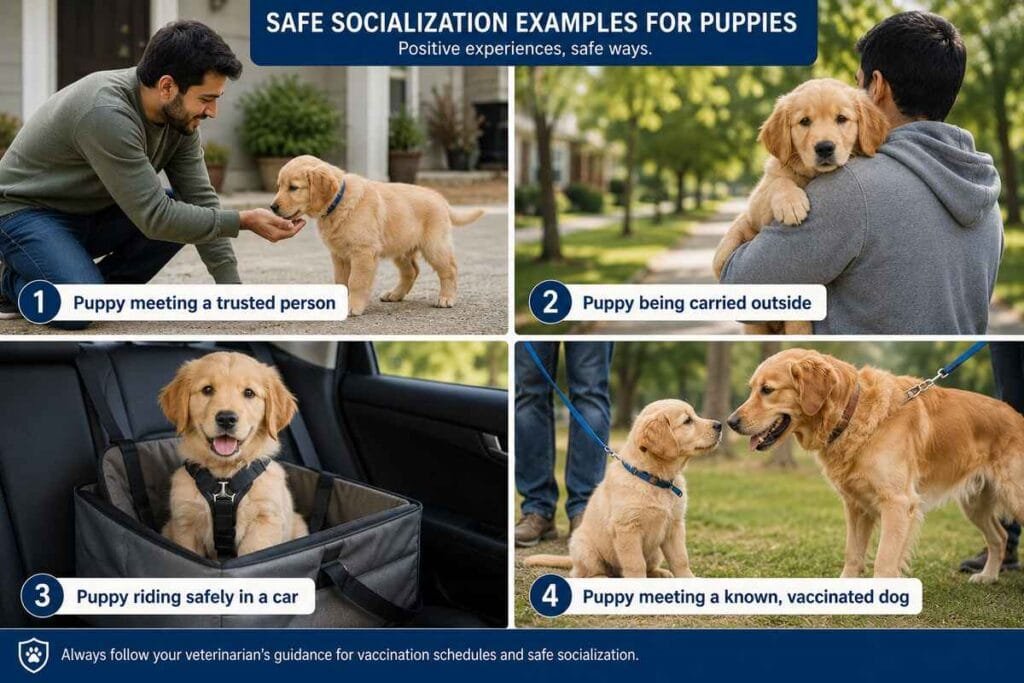
Meet Healthy Vaccinated Dogs
The safest dog-to-dog socialization is with adult dogs whose vaccination status you know for certain. Friends’ vaccinated dogs, family members’ healthy pets, and vet-recommended puppy socialization groups are all good options. Avoid any dog whose health status is unknown or questionable.
Ask owners directly about vaccination status and any recent illness. A vaccinated, healthy adult dog is low-risk even if your puppy is unvaccinated, since the adult dog cannot contract diseases from your puppy.
Invite Trusted Friends
Inviting people to your home to meet your puppy is one of the safest socialization methods. Your puppy gets to meet new people without exposure to disease risks from public areas or unknown animals. Friends who visit create positive associations with meeting strangers.
Encourage friends to handle your puppy gently, play with it, and give treats. Positive interactions with multiple people build your puppy’s confidence around humans.
Visit Family Members
Extended family visits are excellent for puppy socialization. Your puppy gets to spend time in different homes, meet new family members, and experience different environments safely. Multi-generational exposure helps puppies learn that different people are friendly.
Encourage family members of all ages to interact positively with your puppy. Grandparents, teenagers, and young children all provide different interaction styles that broaden your puppy’s social experience.
Car Rides
Short car rides build confidence and desensitize your puppy to travel. Start with very short trips around the neighborhood, then gradually increase the distance and time. Car rides help your puppy learn that traveling is normal and not scary.
Take trips to positive destinations when possible. A short ride to a friend’s house or a scenic area where your puppy can look out the window teaches that cars lead to good things.
Carry Your Puppy in Public
Carrying your puppy while you walk around shopping areas, parking lots, or neighborhoods gives exposure to crowds, vehicles, and different environments without direct ground contact. Your puppy experiences real-world stimuli while remaining protected from disease risk.
Carry your puppy in your arms or in a puppy carrier so it can observe from a safe vantage point. Let it see and hear traffic, crowds, and interesting sights without direct ground exposure.
Sit Outside Stores
Sitting outside a pet-friendly store or shopping center with your puppy on your lap or in a carrier provides safe exposure to busy environments. Your puppy can watch people, hear different sounds, and experience activity without any risk of contamination from unknown animals.
Choose quieter times initially, then gradually progress to busier periods as your puppy becomes more confident. This teaches that crowds and activity are normal.
Watch Traffic
Watching vehicles from a safe distance (your yard, a sidewalk away from the road) helps your puppy become comfortable with car sounds. Start from farther away and gradually move closer as your puppy adjusts. This is especially important for puppies that will live in areas with regular traffic.
Your puppy learns that the loud sounds of traffic are not scary or dangerous. This prevents later anxiety around traffic.
Meet Different People
Expose your puppy to people of different ages, sizes, and appearances. Invite friends of various backgrounds, elderly neighbors, tall people, people wearing hats, and people with different voices. This breadth of human exposure prevents your puppy from becoming fearful of specific types of people later.
Ensure all interactions are positive and controlled. Reward your puppy with treats and praise when it approaches new people confidently.
Introduce Different Sounds
Play sounds around your puppy during normal household activities. Vacuum, run a blender, listen to music, play videos of thunderstorms or fireworks at low volume, and let your puppy hear doorbells, phones, and other household sounds. Early exposure to noise desensitizes puppies and prevents sound anxiety later.
Keep the volume low initially and gradually increase as your puppy becomes comfortable. Pair sounds with positive experiences like treats or play.
Expose to Different Surfaces
Let your puppy walk on grass, tile, carpet, wood, gravel, and other safe surfaces around your home and yard. Different textures and footing build confidence and prevent puppies from being scared of normal ground variations. Some puppies are nervous on slippery surfaces like tile, so early exposure helps.
Start in familiar spaces and gradually introduce new surface types. Reward your puppy for exploring confidently.
Handling Exercises
Gently handle your puppy’s paws, ears, mouth, and tail daily. Brush it, touch its feet, and get it comfortable with being handled by different people. This preparation is essential for grooming, vet visits, and general care. Puppies that are comfortable with handling are much easier to manage throughout their lives.
Make handling exercises positive with treats and praise. This teaches your puppy that handling is a good thing.
Use Positive Treats and Praise
Every new experience should be paired with positive reinforcement. Reward your puppy with high-value treats, happy praise, and play when it investigates new things or meets new people confidently. This creates positive associations with novelty and builds confidence.
If your puppy shows fear or hesitation, do not force the interaction. Simply move away and try again in a few days. Pushing scared puppies can actually increase fear.
Learn more about positive training in our guide on How to Train a Puppy at Home.
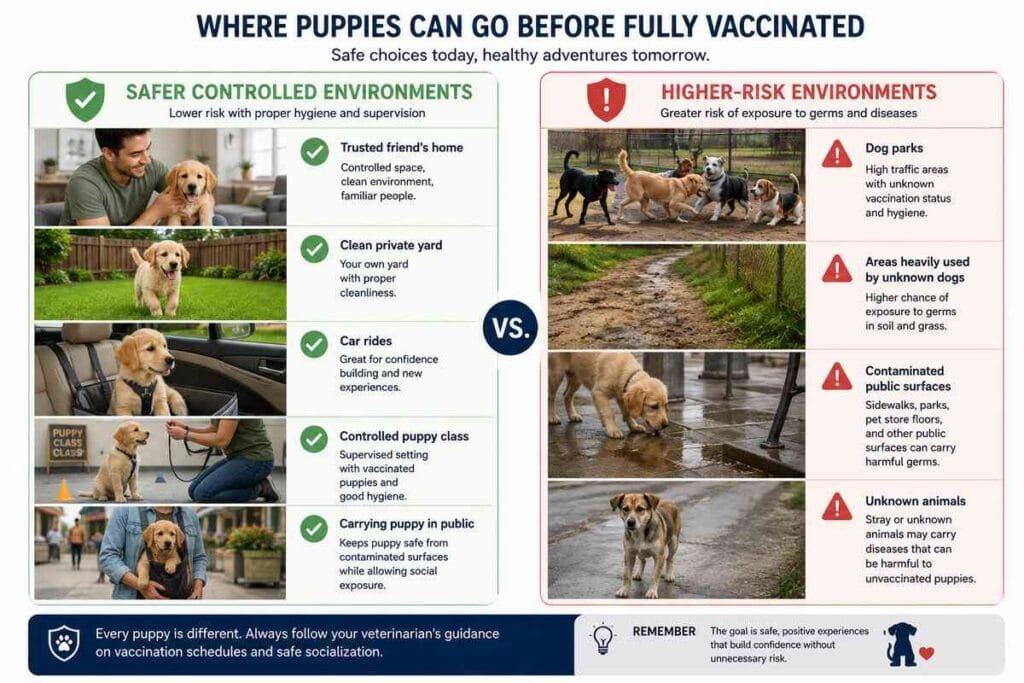
Places That Are Safe Before Your Puppy Is Fully Vaccinated
Certain locations carry low disease risk and are perfect for early socialization. Other locations should be avoided entirely until your puppy is fully vaccinated.
Safe Places for Unvaccinated Puppies
- Your home and yard
- Friend’s house (with vaccinated pets)
- Relative’s yard (known to be clean and safe)
- Carrying your puppy in shopping areas (no ground contact)
- Vet clinic waiting area (if your vet recommends and has separate areas)
- Your car during short drives
- Puppy training class requiring all participants to be vaccinated
Unsafe Places Before Full Vaccination
- Dog parks and off-leash areas
- Public parks and hiking trails with unknown dog traffic
- Pet store floors where many animals have walked
- Dog beaches or swimming areas
- Unknown grass areas or wooded areas with stray animals
- Areas with wildlife like raccoons or opossums that may carry disease
Can an Unvaccinated Puppy Meet Other Dogs?
Yes, but only under specific circumstances with careful selection. Not all dog-to-dog contact is equally risky. The health status and vaccination history of the other dog matters tremendously.
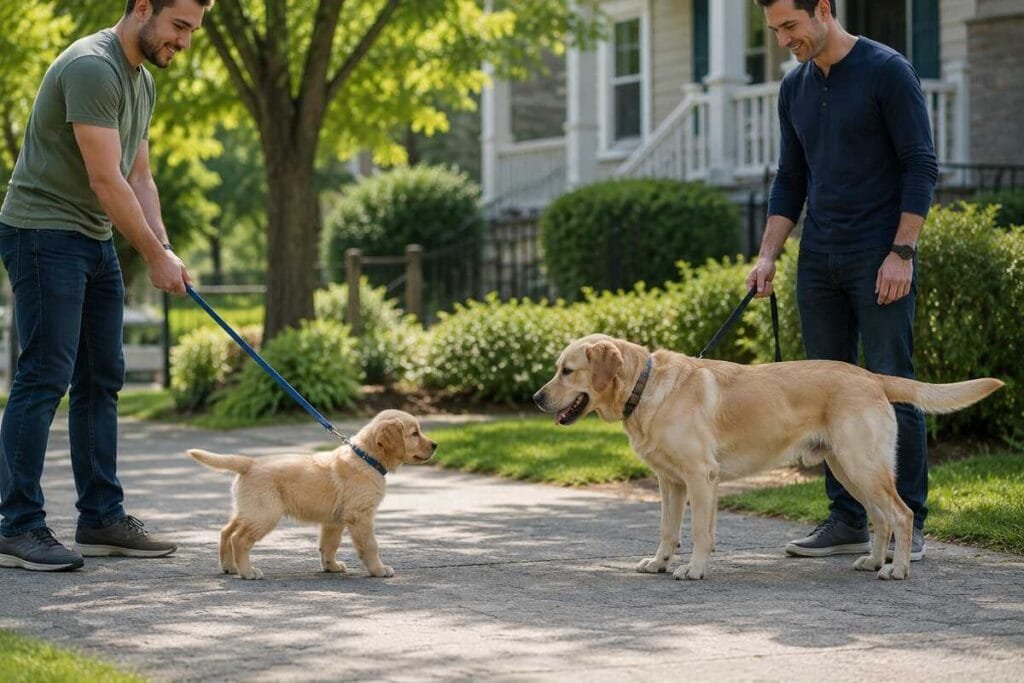
Safe dogs to meet:
- Dogs with confirmed complete vaccination status
- Healthy adult dogs with no signs of illness
- Dogs owned by friends or family whose health practices you know
- Dogs in vet-recommended puppy socialization classes where all dogs must be vaccinated
Dogs to avoid:
- Stray dogs of unknown vaccination status
- Dogs that appear sick or have signs of illness
- Dogs whose vaccination history is unknown or questionable
- Dogs in public dog parks that allow all dogs regardless of vaccination status
If your puppy shows signs of fear around dogs, read our detailed guide on Puppy Scared of Other Dogs.
Puppy Socialization Mistakes to Avoid Before Full Vaccination
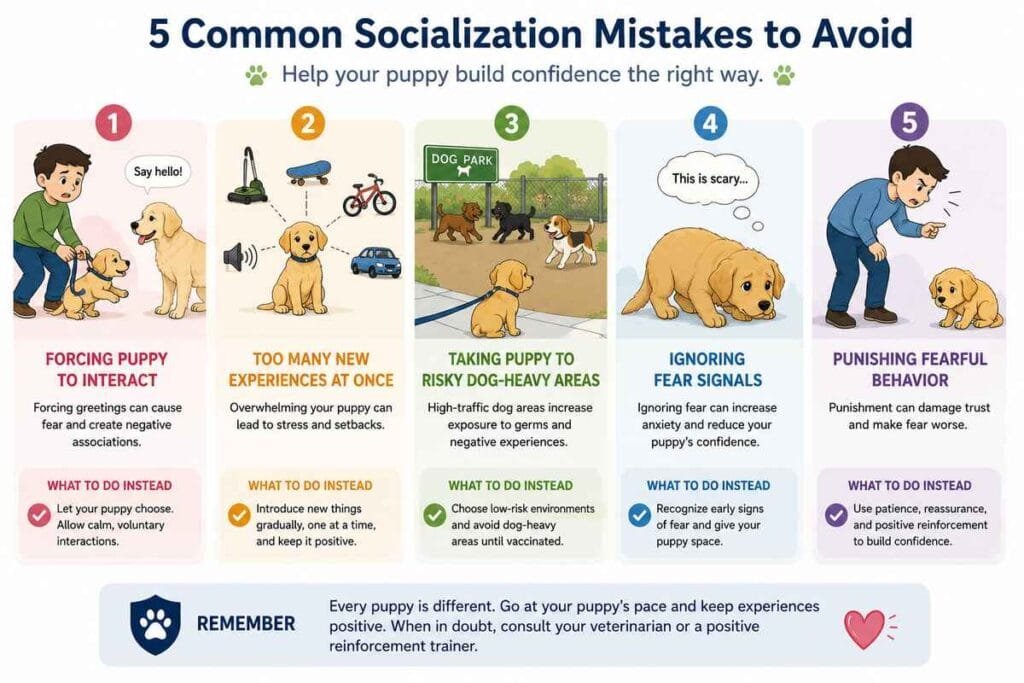
Even well-intentioned owners sometimes make mistakes that harm puppies’ socialization or safety.
- Waiting until vaccines finish: Missing the critical window by being overly cautious means lost opportunity.
- Taking puppy to dog parks too early: Dog parks expose puppies to unknown dogs and potential disease before they’re protected.
- Forcing interactions: Pushing a scared puppy into situations creates negative associations, not confidence.
- Too many experiences at once: Overwhelming your puppy with too much novelty too fast causes stress, not confidence.
- Punishing fearful behavior: Scolding a scared puppy makes fear worse, not better.
- Ignoring stress signals: Missing your puppy’s body language cues means you don’t know when to pause and back off.
How to Know if Your Puppy Is Overwhelmed During Socialization
Learning to recognize stress signals helps you know when to pause socialization and back off.
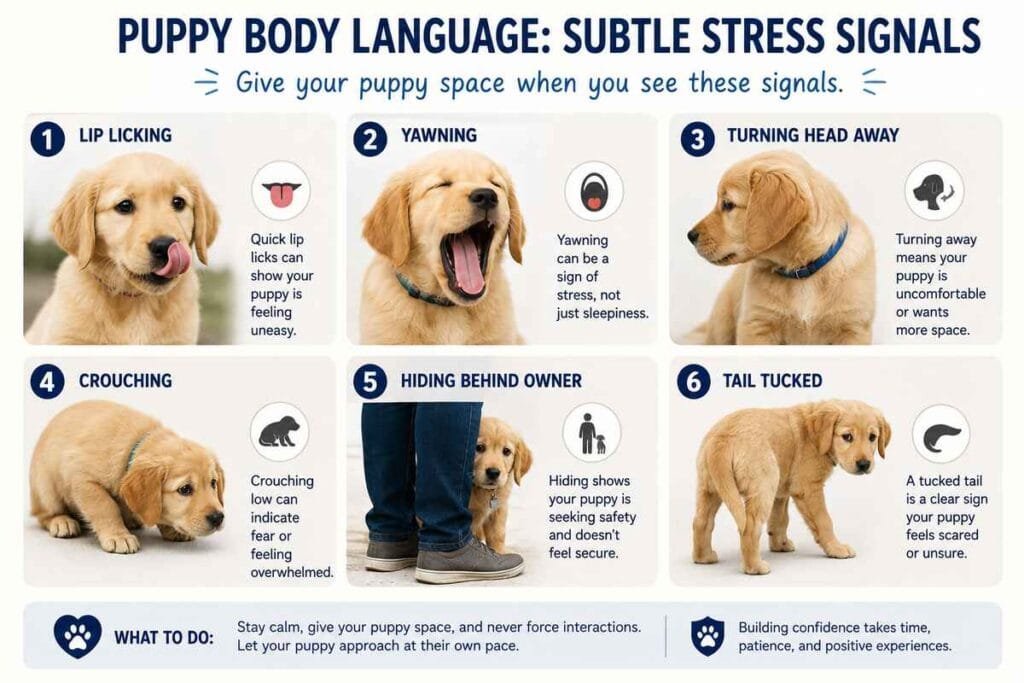
Body Language Signs
- Tucked tail between legs
- Ears pinned back
- Stiff, tense body posture
- Yawning excessively (stress yawn, not tiredness)
- Lip licking or nose licking
- Panting with mouth closed
Fear Signals
- Cowering or freezing in place
- Refusing to move or explore
- Excessive trembling
- Attempting to escape or hide
- Whining or whimpering
When to Stop
If you see any of these signals, stop the activity immediately and move your puppy to a calmer space. Do not force continued exposure. Return to the activity another day at a lower intensity. This teaches your puppy that you understand its signals and respect its comfort level, which actually builds trust and confidence over time.
Weekly Puppy Socialization Checklist
This checklist helps you track which categories of exposure your puppy has experienced each week. Aim to expose your puppy to at least one new thing in each category weekly.
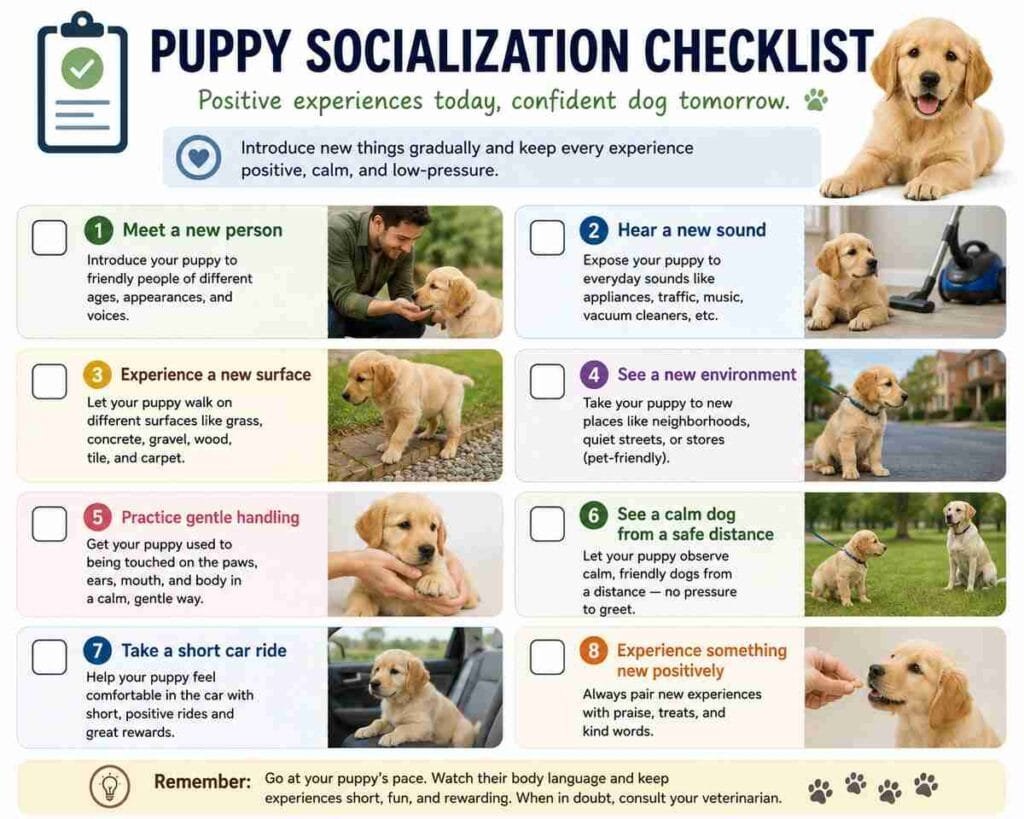
| Category | Week 1 | Week 2 | Week 3 | Week 4 | Notes |
|---|---|---|---|---|---|
| Different people (ages, sizes) | ☐ | ☐ | ☐ | ☐ | Variety is key |
| Vaccinated dogs | ☐ | ☐ | ☐ | ☐ | Positive interactions only |
| Children | ☐ | ☐ | ☐ | ☐ | Gentle interaction |
| Sounds (vacuum, doorbell, etc.) | ☐ | ☐ | ☐ | ☐ | Start quiet, increase volume |
| Vehicles and traffic | ☐ | ☐ | ☐ | ☐ | From safe distance |
| Different surfaces | ☐ | ☐ | ☐ | ☐ | Grass, tile, gravel, etc. |
| Objects (umbrella, hat, toys) | ☐ | ☐ | ☐ | ☐ | Novel items trigger curiosity |
| Gentle handling (paws, ears, mouth) | ☐ | ☐ | ☐ | ☐ | Daily practice |
| New locations | ☐ | ☐ | ☐ | ☐ | Friend’s house, relatives |
| Household noises | ☐ | ☐ | ☐ | ☐ | Blender, washing machine, etc. |
Frequently Asked Questions
Can puppies socialize before vaccinations?
Yes. Puppies should begin socialization during the critical window at 8 to 16 weeks, which overlaps with the vaccination series. The key is choosing controlled environments with low disease risk while your puppy is building immunity.
Can my puppy meet vaccinated dogs?
Yes. Meeting healthy, fully vaccinated dogs is one of the safest forms of dog-to-dog socialization for unvaccinated puppies. Make sure you know the other dog’s vaccination status for certain.
Can I carry my puppy outside?
Yes. Carrying your puppy while you walk around public areas is an excellent, low-risk way to expose it to sights, sounds, and people without direct ground contact. This prevents disease exposure while building confidence.
Can puppies visit pet stores?
Most pet stores are not recommended because pet store floors see many animals and carry disease risk. If your vet allows it, carrying your puppy (not on the floor) in a pet store briefly is safer than letting it walk on the floor.
When should puppy socialization begin?
Socialization should begin as early as 7 to 8 weeks of age when your puppy comes home. The critical window extends until about 16 weeks, so early action is important.
How many experiences should my puppy have each week?
Aim for at least one new experience in each major category (people, sounds, surfaces, environments) each week. More frequent, shorter exposures are better than fewer, longer ones.
When to Call Your Veterinarian
Certain situations warrant veterinary guidance before or after socialization outings. Contact your vet if you notice:
- Signs of illness after an outing (vomiting, diarrhea, lethargy)
- Suspected exposure to an unvaccinated or sick animal
- Severe fear response that doesn’t improve with gentle exposure
- Signs of aggression toward people or other animals
- Extreme anxiety that affects daily functioning
For more information, see our guides on Common Pet Health Problems and Pet Emergency Signs.
Final Thoughts
Socialization starts before your puppy is fully vaccinated, not after. The critical window between 8 and 16 weeks will never come again, so using this time wisely is one of the best investments in your puppy’s future. Keep exposure controlled and positive, avoid truly risky locations, build confidence gradually, and consult your veterinarian when you are unsure about specific situations.
A well-socialized puppy becomes a confident, adaptable adult dog that enjoys life and is easier to manage in all situations. The effort you invest now pays dividends for the next 10 to 15 years of your dog’s life.
Related Articles: Puppy Socialization Checklist: 100 Things to Expose Them To and How to Socialize a Puppy: Complete Age-by-Age Checklist.
Author Bio
Written by David Jason Founder of My Pet Care Tips
David has spent years helping first-time puppy owners build reliable routines for house training, crate training, and daily care, drawing on real-world experience and trusted veterinary guidance to make the process less overwhelming.
Last Updated: July 28, 2026
Sources: American Veterinary Medical Association (AVMA), American Animal Hospital Association (AAHA), American Kennel Club (AKC)
Note: Every puppy is unique, and socialization needs may vary based on breed, temperament, and health status. Consult your veterinarian for personalized guidance on what is safe for your specific puppy.